
Installing Porcelain Tiles on a Concrete Patio for a Chessboard Design
A reader wants to create a permanent chessboard on their concrete patio after painted squares failed. Theyre asking whether porcelain or ceramic tiles can be adhered directly to the concrete and how to prevent shifting.

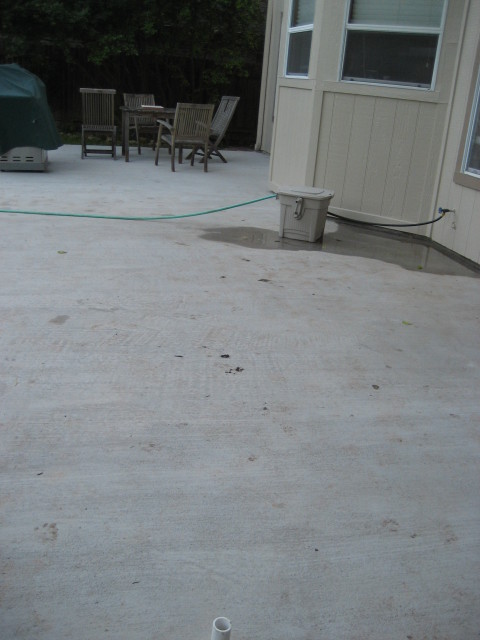
Fixing a Poorly Installed Concrete Patio: Drainage Issues and Missing Joints
A homeowner recently had a concrete patio installed along the length of their house. The very next day, they discovered a persistent puddle about half an inch deep in one corner that refuses to evaporate even in 90-degre
Erosion Control on a Pool Slope: Terraces and French Drains
Terrace the 2–3 ft slope with timber walls; add a French drain on each terrace. French Drain per Terrace Trench 2 ft wide × 3 ft deep. Line with builder’s nylon fabric. 5″ gravel (3″ stone) bed. Lay perforated pipe; co
Railroad Tie Retaining Wall with Drainage: Materials and Methods
A 2–3 ft slope washing into a pool needs a timber wall with proper drainage. Wall Build (per linear foot) 12″ drain rock (¾–1½″) behind wall. Perforated pipe (4″) in fabric sock at base of rock. Keyway trench at toe. D
Pricing Sod and Topsoil Installation: Cost-Plus Method
For 1,340 sq ft sod + 4″ topsoil: Example Cost Build-Up (GA market) Sod: $0.30/sf × 1,340 = $402 Topsoil: 17 cu yd × $25 = $425 Labor (2-man, 2 days): $400 Overhead: $200 Direct Cost Subtotal: $1,427 Profit 30–35%: $42
Using Railroad Ties in the Landscape: Creosote Concerns
Old railroad ties (railway sleepers) have leached most creosote toxins over decades. They’re safe to use for retaining walls, steps, or edging. Design Ideas Stack horizontally (standard). Stand on end (vertical) – bury
Softening a Retaining Wall with Trailing Plants
A stone retaining wall clashing with a rustic brick cottage in Pittsburgh (Zone 6) can be veiled with trailing evergreens. Candidates Variegated ivy (Hedera helix ‘Glacier’, ‘Gold Child’) – evergreen, trails, moderate
Wooded Mountain Lot: Naturalistic Landscape, Not Suburban Manicure
A forested mountain property should be enhanced, not converted to a suburban lawn. Work with the ecology. Steps ID invasive vs. native plants (state list); remove invasives, keep natives. Thin trees for light/views; re
Irrigation Scheduling for Indiana Lawns: July–August
Indiana summer ET ≈ 0.2″/day; lawns need 1–1.5″/week (rain + irrigation). Water deeply, infrequently. Schedule Best time: 4–8 AM (high pressure, low wind, low evaporation). Frequency: One deep soak (1–1.5″) or two equa
Juniper Planting Restrictions: Fire Codes, Not UBC Law
No UBC or state law bans juniper near walls. The claim likely stems from Nevada’s “Living with Fire” guidelines (NDF), which call juniper “little gas cans” and recommend removal from defensible space. This is a voluntary
Raising Grade 5–8 Feet Around 30-Foot Spruce: Survival Odds Low
Burying a 30-ft spruce under 5–8 ft of fill (≈280 tons of gravel over the root zone) will crush roots and rot the root collar. Aeration pipe systems have ~20% success at best. Better Options Tree spade move: Pro mover
Trees for a Narrow Poolside Strip in Ohio: Root and Litter Concerns
A 4-ft wide strip between a pool deck and driveway in Ohio (Zone 5/6, -15 to 105°F, poor drainage) needs shade at 10+ ft without root damage to asphalt, bee-attracting flowers, or heavy leaf drop. Constraints 4 ft widt
Italian Cypress in Massachusetts? Use Hardy Columnar Alternatives
Italian cypress (Cupressus sempervirens) is Zone 7–10; Foxboro, MA is Zone 6—too cold. It also looks overly formal for residential scale. Hardy Columnar Evergreens for Zone 6 ‘DeGroot’s Spire’ Arborvitae – 15–20 ft, 2–
Landscaping a Wet Backyard Trench: Drain, Don't Pond
Hand-dug trenches along property lines that fill with water are temporary ponds, not landscape features. Water must drain away in 48–72 hours. Solutions Perforated pipe + gravel (French drain) to an approved outlet (ci
Cutting Retaining Wall Block Cleanly: Rent a Masonry Saw
Chiseling 12″×4″ Windsor block leaves jagged edges. For 4–5 clean cuts, rent a gas-powered masonry saw (~$50–80/day). Score 1″ deep then chisel if you must, but only a full saw cut gives a smooth face. No cheap hand-too
Sealing a Mortared Stone Walkway: Color, Slip Resistance, and Protection
For mortared stone (not sand-set): Colored mortar: Contrast or match stone; buy pre-bagged or tint on site. Sealer: Use a penetrating sealer (e.g., Rez-Seal)—enhances color, repels water, not glossy/slippery. Avoid fil
Landscape Designer Travel Time Billing: Standard Practice
Designers bill for expertise (time), not materials. Travel time is billable—either built into the hourly rate, a trip minimum, or a separate line item. Plumbers embed travel in their $100–150/hr rate (actual take-home ~$
Crusher Fines Path with Cement: Weed Barrier Options
Crusher fines + Portland cement (stabilized fines) makes a firm, permeable path. Cardboard/newspaper works as a biodegradable weed barrier under the fines—call it “poor man’s fabric.” Lay cardboard (overlap 6″), wet it,
Removing Scrub Trees, Grapevine, and Ivy from a Fence Line
Cut trees (1–5″ dbh) with chainsaw, reciprocating saw, or hand saw. For vines: Cut grapevine/ivy at base; let top growth die (2–4 weeks), then pull down. Apply cut-stump herbicide (glyphosate or triclopyr) immediately
Starting a Flower Bed: Remove Grass or Sheet Mulch?
Turning grass under creates a nitrogen-drawdown period (1 month) as microbes decompose it. Two better options: Sheet mulch: Cardboard/newspaper (4–6 layers) over grass, then 3–4″ finished compost. Plant directly into c


Copyright © www.100flowers.win Botanic Garden All Rights Reserved