
Gray Fur-Like Growth Under House: Likely a Fungus
The grayish, fur-like mound (3–3.5 inches tall) growing on bare soil under your Marin County home is almost certainly a fungus (mushroom/toadstool)—possibly a species of Coprinus (inky cap) or a slime mold in its fruitin

Tree vs. Bush: Is There a Technical Difference?
There is no strict botanical line between tree and bush (shrub). Its a growth-form description: Tree:15 feet at maturity (up to 300+ feet). Shrub/Bush: Multiple stems from base, usually <25 feet tall. You can train a t
Patchouli (Pogostemon cablin) Care: Indoor Growth and Uses
Patchouli is a tropical perennial herb grown for its fragrant essential oil (perfume, insect repellent). Your 20-inch indoor plant is thriving. Care: Light: Bright, indirect; some morning sun. Temperature: Keep above 50
Finding Chinese Photinia (Photinia serratifolia) in Lubbock, Texas
The Serrulata Chinese Photinia is correctly Photinia serratifolia (syn. P. serrulata). Its an evergreen shrub/small tree to 20 feet, hardy to zone 7—suitable for Lubbock (zone 7a). Sources: Local independent nurseries (
Fruit vs. Vegetable: The Botanical and Culinary Distinction
Botanically, a fruit is the mature ovary of a flowering plant, usually containing seeds. It develops from the fertilized flower. Tomatoes, peppers, cucumbers, squash, and beans are fruits. A vegetable is a culinary term
Purple Butterbean (Phaseolus lunatus): Identification and Edibility
The plant with purple vines, leaves, flowers, and hulls, climbing 12 feet, with dry black seeds edged in white, is likely a purple-seeded lima bean, Phaseolus lunatus (butterbean is a common name for large-seeded limas).
Oxalis: The Seed-Shooting Weed Taking Over Virginia Beds
The weed that explodes seeds 20–30 feet when touched is creeping woodsorrel, Oxalis corniculata (or yellow woodsorrel, O. stricta). It has clover-like leaves and small yellow flowers. It thrives in disturbed soil—especia
Removing Yucca (Yucca filamentosa) Near Buried Wiring
The yuckas are almost certainly Adams needle, Yucca filamentosa (hardy to zone 4) if youre in the Northeast/Mid-Atlantic, or a tropical yucca in warmer zones. They form clumps of sword-like leaves with tall (6+ ft) white
Moraine Locust Leaves on Asparagus & Pruning Timing for Zone 5 Trees
1. Moraine locust (Gleditsia triacanthos Moraine) leaves on asparagus: The leaves are high in tannins but not allelopathic. More likely, the leaf layer stayed too wet, causing crown rot. Also, check if your asparagus is
Controlling Invasive Morning Glory Vines from Contaminated Mulch
The small white, petunia-like flowers and aggressive vining habit confirm field bindweed (wild morning glory), Convolvulus arvensis. Its a perennial with deep, extensive roots—hand-weeding alone wont eradicate it. Integr
Dragon Fruit (Pitaya): What Is It?
Dragon fruit (pitaya) is the fruit of several cactus species, primarily Hylocereus undatus (white-fleshed) and Hylocereus costaricensis (red-fleshed). Native to Central America, now widely grown in Southeast Asia. Charac
Learning Edible Wild Plants in the Philadelphia Area
To start learning edible wild plants and weeds near Philadelphia: Contact Penn State Extension (your county office). They offer workshops, fact sheets, and often have Master Gardeners knowledgeable about wild edibles. V
Reverse Variegated Spider Plant (Chlorophytum comosum) Identification
Your spider plant—darker green center, lighter edges ranging to white, no flowers yet—is the reverse variegated spider plant, likely Chlorophytum comosum Variegatum, Vittatum, or Laxum. Key facts: All-green spider plant
Plumeria (Frangipani) Care: Blooming, Pollination, and Basics
Plumeria (often misspelled Plumera) is a tropical deciduous shrub/tree famous for its fragrant, waxy flowers used in leis. It does not require separate male and female plants—each flower has both male (stamens) and femal
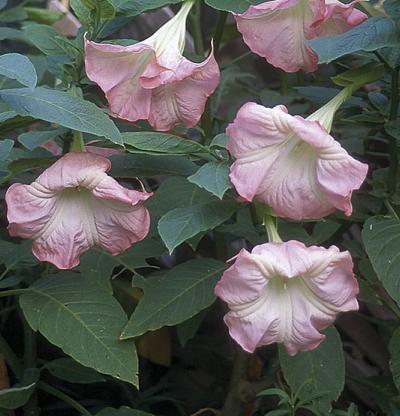
Yesterday, Today, and Tomorrow Plant (Brunfelsia): Care and Names
The shrub with flowers that change from dark purple (Tomorrow) to light purple (Today) to white (Yesterday) is Brunfelsia, commonly called Yesterday-Today-and-Tomorrow. Species/cultivars: Brunfelsia pauciflora (syn. B. c
Identifying a Thorny, Hairy-Leaved Plant in a Wet Area
Your description—thorns on leaf veins and petioles, alternate leaves with fine hairs like soybean, two main taproots with fibrous laterals, strange smell—suggests a few weedy possibilities: Canadian thistle (Cirsium arv
Sedum makinoi 'Ogon': Sun or Shade?
Sedum makinoi Ogon (golden Japanese stonecrop) is a low, mat-forming succulent with tiny, bright gold leaves. It performs best in partial shade to full sun, depending on climate: Cooler climates (e.g., New Jersey): Full
Houseplant Identification Resources and Two Common Crassula & Ficus Varieties
There is no single website where you input leaf traits and get an ID—plant ID requires visual matching. Best approach: Use a search engine with the botanical name (e.g., Crassula ovata tricolor) to find image galleries.
Identifying Clumping Bamboo: Possibly Phyllostachys
A clumping bamboo reaching 30 feet with 7 cm (2.75 inch) diameter culms, oval in cross-section, used for scaffolding—this suggests a large temperate running bamboo, not a clumper. True clumpers (e.g., Fargesia) stay unde
Best USDA Zones for a Wide Variety of Garden Plants
The sweet spot for growing the broadest range of deciduous and evergreen plants is the middle transitional zones—USDA zones 6–8—stretching from the Carolinas to New York on the East Coast, and westward in a band through
Copyright © www.100flowers.win Botanic Garden All Rights Reserved