


| Family: | Cupressaceae (koo-press-AY-see-ee) (Info) |
| Genus: | Thuja (THOO-yuh) (Info) |
| Species: | occidentalis (ok-sih-den-TAY-liss) (Info) |
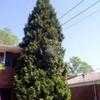
Eastern Arborvitae (Thuja occidentalis), also known as White Cedar, American Arborvitae, or Northern White Cedar, is the quintessential cold-hardy, narrow evergreen conifer of eastern North America. Native from Manitoba to Nova Scotia, south to the Great Lakes and Appalachians, it has been a landscape staple for centuries, prized for its dense, scale-like foliage, formal pyramidal habit, and unmatched utility as a screen, hedge, and windbreak.
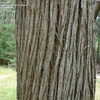
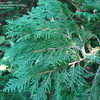
The foliage consists of **flattened, fan-like sprays of tiny, overlapping, scale-like leaves** (1/8 inch), bright green to yellow-green, often bronzing in winter (especially in exposed sites). Crushed foliage emits a pleasant, sweet, cedar-like aroma. The tree is naturally a narrow pyramid, 20–40 feet tall and 10–15 feet wide in cultivation (taller in the wild), with a strong central leader. Bark is reddish-brown, fibrous, peeling in long strips.
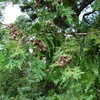
Small, oblong cones (1/2 inch) mature from green to brown, with 8–10 scales. The species is the parent of **countless cultivars** selected for size, shape, and color: 'Emerald Green' ('Smaragd')—narrow, bright green, no bronzing; 'Techny'—compact, dark green, cold-hardy; 'Nigra' (Dark Green)—retains color; 'Pyramidalis'—formal column; 'Hetz Midget'—dwarf globe; 'Degroot's Spire'—narrow columnar. There is an arborvitae for almost every landscape need.
Hardy in USDA Zones 2–7 (some cultivars to Zone 8). **Full sun to part shade**; prefers moist, well-drained, fertile soil but tolerates wet, clay, and alkaline conditions better than most conifers. **Intolerant of drought, salt, and heavy shade.** Bagworms and spider mites can be pests; deer browse heavily in winter. Shear hedges in early summer. A foundational plant for northern gardens: reliable, versatile, and structurally indispensable.
American Sycamore (Platanus occidentalis)
Eastern Dogwood (Cornus florida)
American Plum (Prunus americana): Wild Fruit for Wildlife and Humans
Deodar Cedar (Cedrus deodara): Graceful Himalayan Evergreen
Canadian Hemlock (Tsuga canadensis): Graceful Shade-Tolerant Conifer
American Spikenard (Aralia racemosa): Bold, Native Woodland Perennial with Showy Berries
American Columbo (Frasera caroliniensis): Monocarpic Giant of Eastern Forests
Hosta 'Northern Exposure': Cold-Climate Champion
Hosta 'White Christmas': Krossa-Palmer-Ruh's Winter Celebration
Hosta 'White Feather' – Ethereal White Foliage for Specialized Gardens
American Halo Hosta: A Large Variegated Cultivar from 1999
Hosta 'American Masterpiece' – Patriotic Excellence from 1999
White Poplar (Populus alba): The Silver-Leaved Shade Tree
Japanese Cedar 'Black Dragon' (Cryptomeria japonica): Dark, Dramatic, and Distinctive
Copyright © www.100flowers.win Botanic Garden All Rights Reserved