

Reviving African Violets with Exposed Stems
When African violets lose lower leaves over time, the central stem becomes bare and woody. To rejuvenate, repot every 6 months: remove the plant, shake off loose soil, trim the bottom ½ inch of the root ball, then replan

Hiring a Gardening Coach in Metro Atlanta
If youve inherited a complex landscape and feel overwhelmed, a gardening coach can provide personalized, on-site guidance. Several professionals in the metro area offer plant identification, care schedules, and hands-on
Apricots bloom in late January in Georgia, making flowers extremely vulnerable to inevitable late freezes. Even if blooms survive, March frosts often kill developing fruit. The trees grow fine, but reliable cropping is n
Overseeding Ryegrass in February: Temperature Dependent
Ryegrass needs a minimum soil temperature of 45°F to germinate. February soils in Georgia often hover around 40°F. Wait for a stretch of days with highs above 45°F, or simply delay until March when soils warm reliably. C
Can You Grow Coffee in Georgia?
Coffee (Coffea arabica) is a tropical evergreen that cannot tolerate freezing temperatures. While it thrives in Costa Ricas highlands, Georgia winters will kill it outdoors. You can grow it as a houseplant, but a single
Pruning Oakleaf Hydrangea: Timing and Technique
Oakleaf hydrangea rarely needs pruning, but if it outgrows its space, prune selectively now (late winter/early spring). Remove the longest stems at the base, leaving as many uncut stems as possible. Since it blooms on ol
Measuring Sunlight in the Garden with Light Meters
Accurately assessing sun exposure is crucial for plant selection. While daily observation works, tools like the SunCalc meter (lusterleaf.com) give a simple day-long reading. For precision, the LightScout (specmeters.com
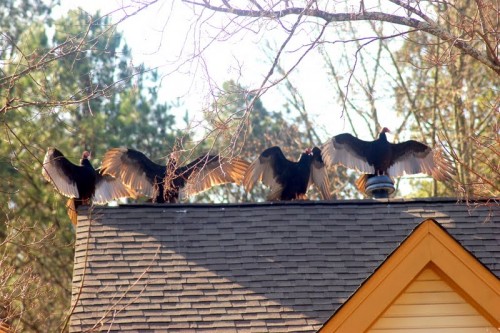
Buzzards (Turkey Vultures) in Georgia: Habits and Identification
The buzzards you see are turkey vultures (Cathartes aura), distinguished by their keen sense of smell—rare among birds. They roost communally in large trees away from human activity, soaring for hours on thermals. In rur
Growing Giant Onions: Sets vs. Sprouted Bulbs
Softball-sized onions come from planting small, dormant sets in early spring. If youre trying to regrow last years sprouted onions, theyll only swell slightly—theyve already used their energy to produce a flower stalk. F
Winter Bronzing on Yoshino Cryptomeria
Its normal for Yoshino cryptomeria to develop a bronze-purple cast in winter, especially on plants exposed to cold, drying winds. The discoloration is temporary—foliage greens up again in spring. As the tree matures, bro
Why Trees Are Grafted and Graft Union Concerns
Nurseries graft trees because its faster and cheaper than rooting cuttings. The graft union is a potential weak point—it can split in high winds or under heavy ice. However, on a sheltered site with proper planting (no d
Choosing and Planting Loropetalum Shrubs
Now is a great time to plant loropetalum, but pick the right variety for your space. Sizes range from 18-inch Purple Pixie to 18-foot Zhuzhou Fuchsia. For foundation plantings, Ruby and Purple Diamond (3–5 feet) are idea
Separating Ponytail Palm Offsets for New Plants
Ponytail palm (Beaucarnea recurvata) produces offsets (pups) at its base. Once a pup has several leaves, gently pull it away from the mother plant and pot it in well-draining cactus/succulent mix. Its not a true palm but
Planting Vidalia Onion Transplants for Sweet Bulbs
Plant Vidalia onion transplants now in a sunny bed, spacing 12 inches apart. Feed regularly with a high-phosphorus fertilizer (e.g., 10-30-20) to encourage bulb development. True Vidalia sweetness comes from low-sulfur s
Safe Slug Control with Iron Phosphate
Iron phosphate baits (e.g., Sluggo) are effective, low-toxicity slug and snail controls. The granules act as a fertilizer but cause iron poisoning in mollusks. Scatter them in the evening on moist soil near vulnerable pl
Saving and Planting Butternut Squash Seeds
You can save seeds from a store-bought butternut, but the resulting fruit may vary if cross-pollination occurred with other Cucurbita moschata varieties. For a fun experiment, dry seeds thoroughly, store in a paper envel
Drip Irrigation for Tomatoes: Emitter Placement and Scheduling
For drip-irrigated tomatoes, run the main line along the row and place two 1-gallon-per-hour emitters per plant, one on each side, 6 inches from the stem. Watering frequency depends on soil type, plant size, and weather.
Will Birds Eat Your Fescue Seed?
Birds rarely consume enough fescue seed to ruin a seeding. At typical overseeding rates (~1 million seeds per 1,000 sq ft), it would take an Hitchcockian flock to make a dent. University of Georgia turf specialist Clint
Leaf Mold vs. Compost: What's the Difference?
Leaf mold is simply composted leaves—no green material added. It decomposes slowly via fungi, resulting in a dark, crumbly material that excels at improving soil structure and water retention. Compost, by contrast, inclu
Identifying Bermuda vs. Fescue in an Atlanta Lawn
Welcome to the South! If your lawn is brown in winter, its almost certainly bermudagrass—the dominant turf in Atlanta subdivisions. Fescue stays green year-round. The immediate priority: apply a pre-emergent herbicide in
Copyright © www.100flowers.win Botanic Garden All Rights Reserved