


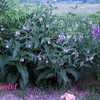
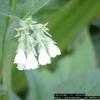
Comfrey (Symphytum officinale) is a robust perennial herb with large, hairy leaves and drooping clusters of bell-shaped purple, pink, or white flowers. It has a long history as a topical healing herb ("knitbone") and is a star in permaculture for its deep taproot that mines nutrients.


| Family: | Boraginaceae |
| Genus: | Symphytum (sim-FY-tum) |
| Species: | officinale (oh-fiss-ih-NAH-lee) |
Native to Europe and Asia, comfrey grows 3–4 feet tall. The leaves are rough and prickly. The taproot can reach 10 feet deep, accumulating potassium, calcium, and other minerals. The sterile hybrid 'Bocking 14' (Russian comfrey) is preferred for gardens as it doesn't self-seed aggressively.
Grow in full sun to part shade, moist, fertile soil. Very tough once established. Harvest leaves multiple times per season. Plant 'Bocking 14' to avoid spread. Hardy in USDA zones 4–9.
Caraway (Carum carvi): Biennial Spice and Medicinal Seed
Common Myrtle (Myrtus communis): Fragrant, Evergreen Mediterranean Shrub for Topiary and Hedges
Anise (Pimpinella anisum): Sweet, Licorice-Flavored Annual for Seeds and Leaves
Licorice (Glycyrrhiza glabra): The Sweet Root of Herbal Medicine and Confectionery
Dorstenia bahiensis: Unusual Tropical Fig Relative with Shield-Shaped Flowers
Catstongue (Priva lappulacea): Tropical Groundcover with Sticky Seeds
Sesame (Sesamum indicum): Ancient Oilseed Crop for Seeds and Oil
Hosta plantaginea: The Fragrant Species with Giant White Flowers
Comfortroot (Hibiscus aculeatus)
Hibiscus hamabo: Coastal Species
Mandrinette – Hibiscus boryanus
Furcraea macdougalii: A Giant, Trunk-Forming Relative of Agave
Euphorbia bupleurifolia: A Bizarre, Pineapple-Topped Succulent with a Caudex
Candelilla (Euphorbia antisyphilitica): A Leafless, Wax-Producing Shrub for Extreme Heat
Copyright © www.100flowers.win Botanic Garden All Rights Reserved