


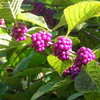
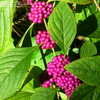
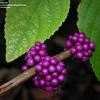
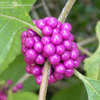
American beautyberry (Callicarpa americana) is a deciduous shrub native to the southeastern United States. It is celebrated for its extraordinary fall display: clusters of brilliant, metallic-purple berries that encircle the stems like jeweled bracelets, persisting after leaf drop.
Arching, loosely branched shrub 1.5–2.5 m tall and wide. Leaves are opposite, ovate, 5–15 cm long, light green, turning yellow in fall. Small, pale pink to lavender flowers appear in dense axillary clusters in early summer. By September–October, these develop into 3–4 mm drupes of intense violet-purple, clustered tightly along the stems.
| Family: | Lamiaceae (lay-mee-AY-see-ee) |
| Genus: | Callicarpa (kal-ee-KAR-puh) |
| Species: | americana (a-mer-ih-KAY-na) |
| Synonyms: | Burchardia americana, B. callicarpa, Callicarpa serrata, C. viburnifolia, Johnsonia americana |
Berries are a critical winter food for over 40 bird species (mockingbirds, robins, towhees, finches) and mammals (deer, raccoons, opossums). Flowers attract native bees and butterflies. Larval host for several moth species.
Naturalistic plantings, woodland edges, wildlife gardens, and mixed borders. The open habit allows underplanting with shade perennials. Prune in late winter to encourage new growth and heavier fruiting. Cut branches are stunning in fall arrangements.
Native Americans used root and leaf teas for medicinal purposes. The berries are astringent but edible; used in jellies and wines. White-fruited forms (f. lactea) occur naturally.
American Beautyberry (Callicarpa americana): Native Shrub with Electric Purple Berries
Korean Mint (Agastache rugosa): Robust, Licorice-Scented Perennial for Tea and Pollinators
Lesser Calamint (Calamintha nepeta): Cloud of Tiny White Flowers for Pollinator Gardens
American Spikenard (Aralia racemosa): Bold, Native Woodland Perennial with Showy Berries
Salad Burnet (Sanguisorba minor): Cucumber-Flavored Perennial
American Beautyberry (Callicarpa americana): Fall's Purple Jewel for Birds and Beauty
American Euonymus (Hearts-a-Busting): Identification and Wildlife Value
Fall Rose Care in Louisville: Watering, Black Spot, and Winter Prep
American Holly (Ilex opaca): The Ultimate Privacy Hedge
American Boxwood (Buxus sempervirens): The 300-Year Landscape Staple
Telegraph Plant (Desmodium gyrans): Leaf-Moving Curiosity
Eastern Sweetshrub (Calycanthus floridus var. glaucus): Fragrant Native Shrub
American Columbo (Frasera caroliniensis): Monocarpic Giant of Eastern Forests
Spineless Caper (Capparis spinosa var. inermis): Thornless Caper Bush for Easy Harvesting
Copyright © www.100flowers.win Botanic Garden All Rights Reserved