


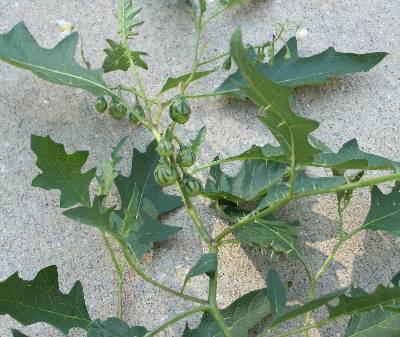
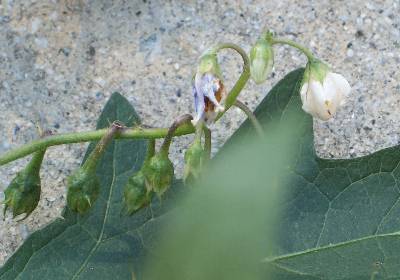
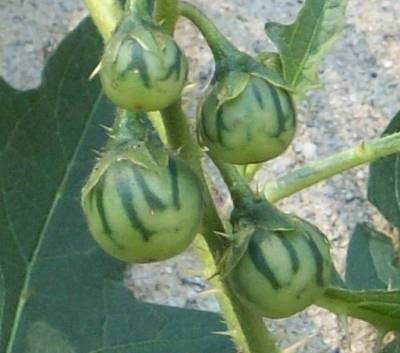
Carolina horsenettle (Solanum carolinense) is a notorious perennial weed that plagues yards, pastures, and wooded areas across the Southeast. If you've encountered a plant with pale purple flowers, watermelon-striped fruits, and vicious spines that penetrate leather gloves, you've likely met this painful intruder.
Horsenettle grows 12–36 inches tall in semi-shaded, woody areas. Its shallow, mat-forming root system springs from a central taproot. The most distinctive—and painful—trait is the sharp, needle-like spines covering stems, leaf stalks, and major leaf veins on both surfaces. Even seedlings come armed. The ½-inch globular fruits start green with dark streaks, ripening to yellow.
Beyond the spines that make barefoot walks memorable for all the wrong reasons, horsenettle spreads aggressively via seeds and creeping rootstocks. It competes with desirable plants and its berries are toxic to livestock and humans if ingested in quantity.
Manual removal is the most permanent solution for small infestations. Use a sturdy trowel or shovel to dig deep and extract the entire root system. Bag and trash the plant—don't compost, as roots can resprout.
Herbicide treatment requires persistence. Glyphosate (Roundup) or 2,4-D (Weed B Gon) will kill top growth, but the deep perennial roots demand multiple applications timed to active growth periods. Spot-treat carefully to avoid desirable plants.
Prevention hinges on maintaining dense, healthy turf or groundcover to deny horsenettle the bare soil it needs to establish.
Gardenia Identification and Chlorosis Correction
Identifying a Cascading "Fish Hook" Succulent: Likely Senecio or Othonna
Unidentified Orchid: General Care When ID Fails
Identifying Common Nepenthes Hybrids: deRoose Varieties and Rebecca Soper
Chandelier Plant (Kalanchoe tubiflora): Striking but Invasive Succulent
Identifying Clerodendrum Species: Peanut Butter Plant and Red-White-Blue Plant
Identifying a Mystery Plant Near La Grange, Texas
Identifying a Mystery Sundew: Tropical vs. Temperate
Identifying Variegated Creeping Charlie (Glechoma hederacea 'Variegata')
Identifying Hare's Foot Fern (Polypodium aureum)
Podocarpus macrophyllus (Buddhist Pine) Sticky Sap = Scale Insects
Copyright © www.100flowers.win Botanic Garden All Rights Reserved