


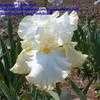

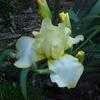
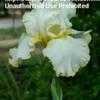
Hybridized by Mohr and introduced in 1971, Iris 'Bride's Halo' carries a name of ethereal beauty—suggesting a luminous, perhaps white or pale blend cultivar with a glowing aura reminiscent of a bridal veil. The Mohr name in iris breeding is historic, tracing back to William Mohr's pioneering work with oncocyclus and regelio-cyclus hybrids in the early 1900s.
William Mohr (1871–1923) revolutionized iris breeding by crossing tall bearded irises with oncocyclus (aril) species, creating the "Mohr-type" arilbreds. His work introduced dramatically new patterns, veining, and forms. While 'Bride's Halo' (1971) is a standard TB (not an arilbred), it may carry genetic traces of that innovative lineage. Later Mohr-family or Mohr-line hybridizers continued registering TBs with distinctive character.
The name 'Bride's Halo' strongly suggests a white, near-white, or pale pastel cultivar—perhaps a luminata (pale ground with darker veining) or a clean self with a glowing quality. 1971 places it in the early modern form era: broad falls with ruffling, good branching, heavy substance. The "halo" might refer to a luminous rim on the falls or a pale aura around the beard. A cultivar designed for evening garden brilliance.
Pale TBs like 'Bride's Halo' are invaluable for moon gardens, white borders, and evening enjoyment. They reflect twilight beautifully and show well in shade. Culture: full sun (tolerates light shade), well-drained soil, shallow planting. White/near-white cultivars sometimes show "muddy" tones in extreme heat—afternoon shade helps in hot climates. Divide every 3–4 years. A romantic addition to any iris collection.
Tall Bearded Iris 'Hemstitched': A 1989 Hager Textural Wonder
Tall Bearded Iris 'Mesmerizer': A 1990 Byers Hypnotic
Tall Bearded Iris 'Ocelot': A 1997 Ghio Spotted Wonder
Tall Bearded Iris 'Seafarer': A 1948 Butterick Voyage
Tall Bearded Iris 'Swerti': A 1612 Historic Survivor
Tall Bearded Iris 'Buckwheat': A 1988 Byers Introduction
Tall Bearded Iris 'Conjuration': A 1988 Byers Introduction
Tall Bearded Iris 'Fogbound': A 1997 Keppel Introduction
Tall Bearded Iris 'Jumping': A 2000 Schreiner Introduction
Tall Bearded Iris 'Liaison': A 1986 Ghio Introduction
Copyright © www.100flowers.win Botanic Garden All Rights Reserved