



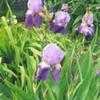
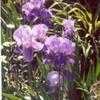
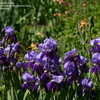
Collected by Sir Michael Foster in 1885, Iris 'Amas' represents one of the earliest named tall bearded iris selections—predating organized hybridization programs and originating as a wild-collected or early garden form. Foster, a Cambridge physiology professor and pioneering iris enthusiast, was instrumental in establishing the scientific basis for iris classification and breeding.
Foster (1836–1907) transformed iris cultivation from a hobby into a science. His 1885 collection of 'Amas' (likely from the Amasya region of northern Turkey, a center of Iris diversity) represents the raw genetic material from which modern TB irises were built. Foster's work with species like I. mesopotamica, I. cypriana, and I. pallida created the tetraploid lines that underlie virtually all modern tall bearded irises.
As an 1885 collection, 'Amas' is not a hybrid in the modern sense but a selected form of a species or natural hybrid. It likely exhibits the simpler, species-like characteristics: narrower petals, less branching, lighter substance, but potentially intense color, fragrance, and the rugged vigor of wild progenitors. Growing 'Amas' is like growing a piece of the genetic foundation of every modern TB iris.
Culture follows species iris preferences: full sun, very well-drained soil (gritty, alkaline ideal), shallow planting. May be more susceptible to modern garden diseases than selected cultivars. Invaluable for species iris collections, historical gardens, and breeding programs seeking to reintroduce lost genetic diversity. A living link to the origins of the modern tall bearded iris.
Tall Bearded Iris 'Ocelot': A 1997 Ghio Spotted Wonder
Tall Bearded Iris 'Seafarer': A 1948 Butterick Voyage
Tall Bearded Iris 'Swerti': A 1612 Historic Survivor
Tall Bearded Iris 'Acoma': A 1987 Magee Introduction
Tall Bearded Iris 'Bewilderbeast': A 1994 Kasperek Marvel
Tall Bearded Iris 'Fogbound': A 1997 Keppel Introduction
Tall Bearded Iris 'Jumping': A 2000 Schreiner Introduction
Tall Bearded Iris 'Liaison': A 1986 Ghio Introduction
Tall Bearded Iris 'Rustler': A 1987 Keppel Introduction
Tall Bearded Iris 'Sambuca': A 2001 L. Johnson Introduction
Copyright © www.100flowers.win Botanic Garden All Rights Reserved