


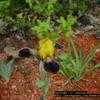
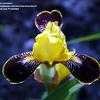

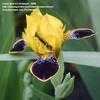
Hybridized by Norrick and introduced in 1985, Iris 'Bumblebee Deelite' is a delightful Miniature Tall Bearded (MTB) iris whose name perfectly captures its charm—evoking the busy, buzzing energy of a bumblebee and the pure delight of discovering a perfectly formed miniature iris flower.
Often called "table irises," MTBs stand 16–27.5 inches tall with flowers 3–6 inches across—small enough for bouquet arrangements but large enough to show intricate detail. They bloom with the tall bearded irises but on more slender, graceful stems. MTBs are prized for their refinement: delicate coloring, intricate veining and stippling, and an elegance that some find more appealing than the bold showiness of modern TBs.
'Bumblebee Deelite' likely displays the characteristic MTB patterning—perhaps yellow and brown blends, veining, or stippling reminiscent of a bumblebee's coloration. Norrick's 1985 introduction represents the MTB renaissance of the 1980s, when hybridizers began applying modern breeding techniques to this class, improving substance, branching, and vigor while retaining the class's innate grace.
MTBs excel in the middle of perennial borders, cottage gardens, and cutting gardens. Their slender stems sway gracefully in breeze. Cultural needs: full sun, well-drained soil, shallow planting. They increase steadily but not aggressively. Divide every 3–4 years. Excellent companions for peonies, daylilies, and other late-spring perennials. A class that rewards close inspection—plant where their delicate beauty can be appreciated up close.
Immortality Tall Bearded Iris: A Reblooming White Beauty from 1982
Clarence Tall Bearded Iris: A Soft Blue Rebloomer from 1990
Superstition Tall Bearded Iris: A Dark, Dramatic Cultivar from 1977
Wabash Tall Bearded Iris: A Historic Bicolor from 1936
Tall Bearded Iris 'Breakers': A 1986 Schreiner Classic
Tall Bearded Iris 'Silverado': A 1986 Schreiner Silver Beauty
Tall Bearded Iris 'Dauntless': A Historic 1929 Heirloom Cultivar
Tall Bearded Iris 'Amas': An 1885 Foster Collection
Tall Bearded Iris 'Hemstitched': A 1989 Hager Textural Wonder
Tall Bearded Iris 'Mesmerizer': A 1990 Byers Hypnotic
Tall Bearded Iris 'Ocelot': A 1997 Ghio Spotted Wonder
Copyright © www.100flowers.win Botanic Garden All Rights Reserved