



| Family: | Aloaceae |
| Genus: | Aloe (AL-oh) (Info) |
| Species: | dichotoma (dy-KAW-toh-muh) (Info) |
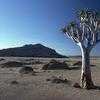
The Quiver Tree, or Kokerboom in Afrikaans (Aloe dichotoma), is one of southern Africa's most striking and recognizable succulent trees. Endemic to the arid regions of Namibia and the Northern Cape of South Africa, this architectural marvel dominates rocky slopes and desert plains, its silhouette an emblem of the harsh, beautiful landscapes it calls home.
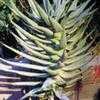
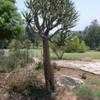
Unlike typical aloes that form stemless rosettes, the Quiver Tree develops a massive, smooth, golden-bronze trunk that can reach 20–30 feet (6–9 m) tall. The trunk bifurcates repeatedly (hence dichotoma, "forked") into a rounded crown of dense, blue-green rosettes. The leaves are thick, fleshy, and edged with small brown teeth, perfectly adapted for water storage.
The bark is a marvel of evolutionary engineering: a smooth, white, powdery coating reflects intense solar radiation, while the fibrous interior tissue stores water. In winter (June–July), mature trees produce spectacular branched inflorescences bearing tubular bright yellow flowers, a vital nectar source for sunbirds, bees, and baboons.
The common name "Quiver Tree" derives from the San (Bushmen) practice of hollowing out the soft, fibrous branches to make quivers for their arrows. The dead, hollowed trunks have also been used as natural refrigerators—food stored inside stays cool due to the insulating properties of the fibrous wood.
Ecologically, it is a keystone species in the Succulent Karoo and Nama Karoo biomes, providing perches for raptors, nesting sites for sociable weavers, and moisture/food for numerous animals.
Listed as Vulnerable on the IUCN Red List, Aloe dichotoma faces threats from climate change (increasing aridity), habitat loss, and collection. It is slow-growing but long-lived (centuries). In cultivation (USDA Zones 9–11), it demands full sun, exceptional drainage, and minimal water—thriving in rock gardens, xeriscapes, and large containers where its sculptural form shines. It is a flagship species for desert botany and a symbol of resilience.
Joshua Tree (Yucca brevifolia): Mojave Desert Icon
Grass Tree (Xanthorrhoea nana): Dwarf Australian Grasstree
Tulip Poplar (Liriodendron tulipifera)
Camphor Tree (Cinnamomum camphora)
Orchid Tree (Bauhinia monandra): Butterfly Leaves and Pink Flowers
Brazilian Pepper Tree (Schinus terebinthifolius)
Sapphire Dragon Tree (Paulownia kawakamii): A Rare Taiwanese Tree with Violet Flowers
The Cocoa Tree (Theobroma cacao): From Tropical Forest to Chocolate Bar
Chaya (Cnidoscolus chayamansa): Nutritious Tree Spinach of the Maya
Tropical Almond (Terminalia catappa): Coastal Shade Tree with Edible Nuts
Gold Medallion Tree (Cassia leptophylla): Spectacular Summer Blooms
Japanese Tree Lilac: Fragrant Ivory Plumes on a Tough Urban Tree
Copyright © www.100flowers.win Botanic Garden All Rights Reserved