


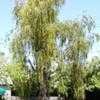
Weeping Bottlebrush is the most elegant of the bottlebrushes, combining the signature red brush-like flowers with a graceful, strongly weeping habit. Callistemon viminalis (family Myrtaceae) is native to eastern Australia, where it grows along watercourses—its pendulous branches trailing into the water.
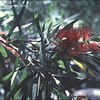
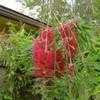
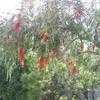
This large shrub or small tree grows 15-30 feet tall with a broad, weeping canopy. The branches cascade downward, often reaching the ground. The leaves are narrow, lanceolate, 3-5 inches long, aromatic when crushed (lemony), evergreen. The flower spikes (3-6 inches) are brilliant red, composed of hundreds of stamens, appearing in spring and often repeating in summer/fall. They're borne on the ends of the weeping branches, creating a curtain of color.
| Family: | Myrtaceae (mir-TAY-see-ee) |
| Genus: | Callistemon (kal-lis-STEE-mon) |
| Species: | viminalis (vim-in-AY-liss) |
Weeping Bottlebrush is superb as a specimen tree where its form can be appreciated—near water features, on slopes, or as a focal point. It also works as a screen or informal hedge. It prefers full sun, well-drained soil, and is drought-tolerant once established. It tolerates wet soil better than most callistemons (reflecting its riparian origins). It's hardy to zone 9a (20°F).
Like other bottlebrushes, it's a hummingbird and bee magnet. Prune after flowering to maintain shape; it can be trained as a single-trunk tree or allowed to grow as a multi-stemmed weeping shrub. The cultivar 'Captain Cook' is a compact, non-weeping selection. For a weeping habit in cooler zones, consider Prunus 'Snow Fountains' or Betula 'Youngii'.
Trailing Jade (Senecio jacobsenii): A Cascading Succulent Vine
Weeping Brown Sedge 'Bronzita' (Carex flagellifera): Cascading Bronze Foliage
Chonta Palm (Juania australis): Rare Chilean Palm
European Hornbeam (Carpinus betulus): The Classic Hedge & Shade Tree
Plumeria pudica: The Everblooming, Evergreen Frangipani
Durian (Durio zibethinus): The King of Fruits—Love It or Hate It
Washingtonia × filibusta: The Hybrid Fan Palm for Marginal Climates
Copyright © www.100flowers.win Botanic Garden All Rights Reserved