


1. Home
  2. Question and Answer
  3. Houseplants
  4. Garden Articles
  5. Most Popular Plants
  6. Plant Nutrition

Liquid Lawn Fertilizer: Types, Benefits, Application, and Buying Guide

Liquid fertilizers deliver nutrients in solution—fast absorption, even coverage, and easy application via hose-end or tank sprayer. They excel for quick green-up, spoon-feeding, and hard-to-reach areas. This guide covers types, pros/cons, organic vs. synthetic, product categories, and selection criteria.
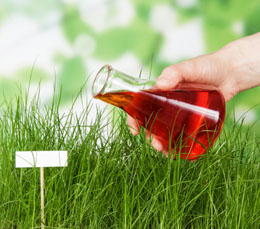
Liquid fertilizer hose-end sprayer

How Liquid Fertilizers Work

  • Nutrients dissolved in water → immediate availability via foliar uptake (hours) and root uptake (days).
  • Applied via hose-end sprayer (ready-to-use) or tank sprayer (concentrate).
  • Uniform coverage on uneven terrain—granular can't match this.
  • Low salt index → minimal burn risk at label rates.

Forms Available

FormDescriptionPrepBest For
Ready-to-use (RTU)Pre-diluted, hose-end bottleAttach to hose, spraySmall lawns, convenience, beginners
Concentrate (liquid)Dilute per label (e.g., 1:15)Mix in tank sprayerMedium-large lawns, cost efficiency
Water-soluble powderDissolve in waterMix in tankHigh analysis, storage stability
Foliar-specificLow N, high micros, surfactantsTank sprayerQuick green-up, stress relief, micros

Advantages

  • Even, controllable coverage (no streaks, no "missed strips")
  • Fast results: visible green-up in 24–72 hrs (foliar N)
  • Spoon-feeding: light, frequent apps (0.1–0.25 lb N/1,000 sq ft) = steady growth, no surge
  • Tank-mix compatible: combine with herbicides, insecticides, fungicides, biostimulants (jar test first)
  • No dust, no spreader calibration, no cleanup
  • Effective on slopes, narrow strips, around trees where spreaders fail

Disadvantages

  • Higher cost per lb N (2–5× granular)
  • Frequent application needed (low N per app) → labor/time
  • Short residual (2–4 weeks) vs. slow-release granular (8–12 weeks)
  • Storage: heavier, can freeze, settle, degrade
  • Not practical for > 1 acre without tank/boom system

Organic vs. Synthetic Liquid Fertilizers

AspectSyntheticOrganic
SourceUrea, ammonium nitrate, potassium nitrate, chelated microsFish hydrolysate, seaweed/kelp, molasses, compost tea, humates, amino acids
SpeedVery fast (hours)Moderate (days–weeks; microbial mediation)
Soil healthNeutral to negative (salt, no carbon)Positive (feeds microbes, adds carbon)
OdorMinimalFish/seaweed: noticeable, fades
CostLowerHigher
AnalysisHigh N-P-K (20-20-20, 30-0-0)Low N-P-K (2-3-1, 5-1-1) + micros

Hybrid approach: Synthetic for primary N; organic for soil biology + micros. Best of both.

Product Categories (Per Industry Classification)

  • Nitrogen carriers: UAN (urea-ammonium nitrate), ammonium nitrate solution, calcium nitrate. High N, fast.
  • Complete fertilizers (N-P-K): Balanced (10-10-10), high-N (20-5-10), starter (10-20-10).
  • Iron + micronutrient products: Ferrous sulfate, FeHEDTA, FeEDDHA, manganese, zinc. Correct chlorosis.
  • Biostimulant / carbon-based: Humic/fulvic acids, seaweed extract, molasses, amino acids. "Bugs in a jug." Enhance uptake, stress tolerance.

Application Best Practices

  1. Calibrate: Run sprayer over 1,000 sq ft test → measure volume used → calc rate.
  2. Morning or evening (avoid leaf burn midday).
  3. Water lightly after if foliar-only product (moves N to root zone).
  4. Don't apply before heavy rain (runoff waste).
  5. Clean sprayer thoroughly between products (especially herbicide → fertilizer).
  6. Follow label rates. More ≠ better. Burn risk at 2×+.

When to Choose Liquid

  • Quick green-up for event/sale
  • Spoon-feeding program (weekly/biweekly light apps)
  • Slopes, narrow beds, tree rings
  • Tank-mixing with other treatments
  • Correcting micronutrient deficiencies (Fe, Mn, Zn)
  • Organic/biostimulant program

When Granular Wins

  • Large lawns (> 10,000 sq ft) primary feeding
  • Slow-release seasonal feeds (2–4×/yr)
  • Budget-conscious annual program
  • Pre-emergent herbicide combos (granular carriers)

Liquid fertilizer is a precision tool. Used strategically—supplemental, corrective, or spoon-feeding—it delivers results granular can't match. As a sole program, it's expensive and labor-intensive.

Copyright © www.100flowers.win Botanic Garden All Rights Reserved