


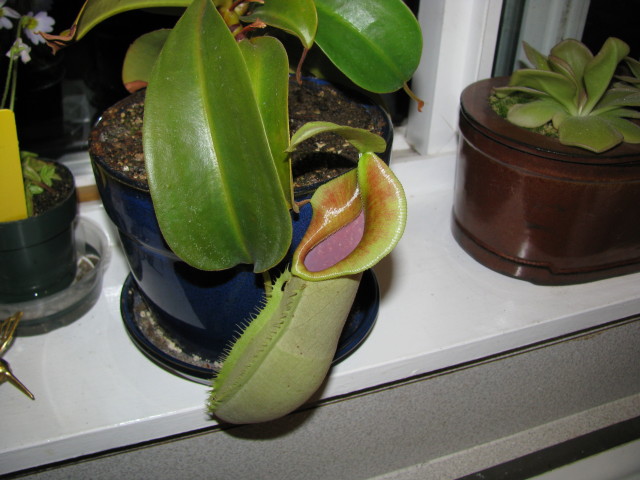
Unknown Nepenthes
This plant is likely one of the "Poi Dogs"—unnamed Hawaiian hybrids often sold at markets. Based on the pitcher morphology, it appears to be a Nepenthes spathulata hybrid. These hybrids are vigorous and can become quite large over time.
Whether to hang your Nepenthes or let it sit on a windowsill is largely personal preference. These plants adapt well to both setups. They're perfectly happy on a counter or sunny windowsill as long as they receive bright, indirect light and consistent moisture.
Repotting timeline: Nepenthes tolerate being slightly root-bound. Repot every 2–3 years, or when the plant appears crowded. If it's growing well, there's no rush.
Division: Unlike Sarracenia, Nepenthes cannot be divided by separating rhizomes. They are stem-forming vines. Those "offshoots" are actually nodes producing new stems, and they lack independent root systems. To propagate them, you'd need to take stem cuttings and root them separately.
With proper care, this hybrid will continue producing impressive pitchers year after year.
Nepenthes Basal Shoot with Unusual Leaves: Normal Juvenile Growth
Identifying a Mystery Nepenthes: deRoose's Alata
Why Hydroponic Pearls Fail as Nepenthes Growing Media
Growing Nepenthes ampullaria from Seed: Viability Warning and Expert Resource
Growing Nepenthes 'Caesar': Conditions, Acclimation, and Fertilization
Moving Large Nepenthes Miranda Outdoors in Alabama (Zone 7)
Growing Nepenthes rajah: Temperature Challenges and Vacation Watering
Growing Nepenthes from Seed: Viability and Resources
Managing the Vining Habit of Nepenthes × wrigleyana
Nepenthes gymnamphora Care: Light, Humidity, and Temperature
Growing Nepenthes x coccinea: A Lowland Hybrid for Warm, Humid Conditions
Indoor Hanging Pots for Nepenthes: Watering Techniques and Multi-Species Planting Pros/Cons
Ghost Plant Identification: Indian Pipe (Monotropa uniflora)
Copyright © www.100flowers.win Botanic Garden All Rights Reserved