


AF Venosa
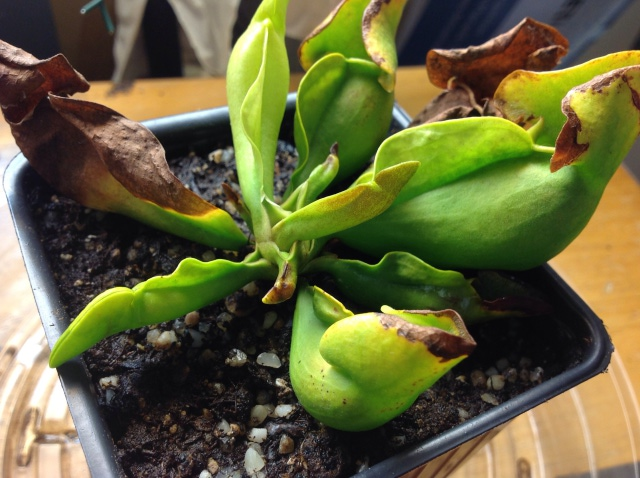
QUESTION: My 2 AF plants are growing with discolouring pitchers, some come out normal & some come out dis-coloured. I'm in fear I have a pest problem, here are my growing conditions:
ANSWER: Hello Michael,
There are actually several possible reasons why pitchers come out discolored and dried out/damaged like the ones in your picture.
Pests are a concern; however, if there are no pests on the young leaves, like aphids, scale etc., then it must be a pest that hides during the day or there is another problem altogether.
If there has been a major drop in temperature or humidity recently, it can damage the new leaves of a plant. You have not indicated any such drop, so we are assuming that they have remained stable in both environmental areas.
If any chemicals are being used near the plant, it could be the cause of the issue. (Make sure to use fungicides and pesticides that are not soap based).
This brings us to lighting. I have not experienced any such damage to my S. purpurea leaves; however, I have seen similar damage on Nepenthes leaves in the past. It was caused by inadequate light. There simply was not enough intensity of light to maintain pitcher formation in the leaves. For example, I have my Sarracenia indoors under fluorescent lights like you do; but mine are under 12 T-12 tubes over a foot from the plants and the tubes are cool white. That equates to over 36,000 lumens on the plants in a 3 x 4 foot area. Sarracenia purpurea need far more light than virtually any other carnivorous plant. You may need to supplement their light with window light and additional fluorescent tubes. Go by lumen, not so much by spectrum. Cool white covers the main spectrum of light they need, but they really require intensity of at least 25,000 lumens for long term growth. Yes, placing the lights closer helps, but only so far as the base intensity of the lamps allows for. If possible, try growing them outdoors. Sarracenia purpurea are generally zone 4 plants and can handle very cold winters as long as they have moisture and some cover. They winter sometimes for over 4–6 months in some regions as far North as Canada.
---------- FOLLOW-UP ----------
QUESTION: Not a question but the bulbs are 4 feet long, & the 3000K are 2800 lumen & the 6400K are higher I do believe. I'm curious: I've been reading if it were scale would I be able to see them?
Answer
Your T-8 tubes are fine, but in greater quantity since total lumens would be less than half what most Sarracenia require. Also, cool white produces less heat and generally a spectrum range wide enough to provide enough color variance for proper plant growth.
T-12 tubes are simply a bit wider than T-8 tubes, but T-8 tubes are becoming quite efficient, packing just as many lumens into a smaller package.
As of now I do not have a method of uploading images into my computer.
Terrarium vs. Windowsill for Mixed Carnivores in Canada: Light, Dormancy, and Species Separation
Nepenthes coccinea & sanguinea Not Pitchering in UK: Light Is the Issue
Sarracenia flava Deformed Pitchers: Insect Damage to Growing Tip
Sarracenia flava Wavy, Thin Pitchers in Florida: Needs Full Sun
Why Your Nepenthes Miranda Isn't Producing Pitchers
Leggy Umbrella Plant (Schefflera) Needs Light, Not a 60-Watt Bulb
Indoor Year‑Round Vegetables in a Canadian Apartment: Realistic Limits
Seasonal Pitcher Development in Nepenthes 'Miranda' and sanguinea
Diagnosing Discolored Pitchers on Sarracenia 'AF Venosa'
Nepenthes sanguinea Not Producing Pitchers After Repotting and Relocation
Diagnosing Stunted Purple Pitcher (Sarracenia purpurea) in Mixed Bog
Troubleshooting Pitcher Failure in Indoor Nepenthes: Light, Humidity, and Fertilization
Daylily Light and Climate Requirements: Adapting to Your Zone
Copyright © www.100flowers.win Botanic Garden All Rights Reserved