


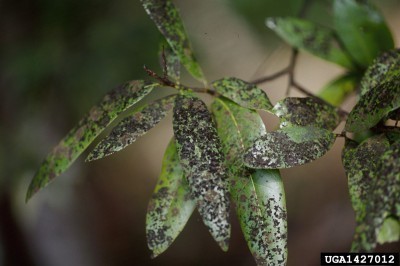
If your plant looks like it's been dusted with black soot, you're likely dealing with sooty mold — a fungal growth that, while unsightly, signals an underlying pest problem rather than a direct plant disease.
Sooty mold fungi grow on honeydew, the sticky, sugar-rich excretion produced by sap-feeding insects such as aphids, scale, whiteflies, and mealybugs. The mold itself doesn't infect plant tissue; it simply uses the honeydew as a food source. Where pests go, sooty mold follows.
Leaves, twigs, and branches develop a grimy, black coating that can resemble fireplace soot or ash. Heavily coated foliage may have reduced photosynthesis. Plants prone to pest infestations — gardenias, roses, citrus, and many others — are frequent hosts.
The key is eliminating the pest source. Once the insects are controlled, the honeydew supply stops, and the mold weathers away or can be washed off with a strong spray of water or a mild soap solution.
Neem oil is particularly useful because it acts as both an insecticide (controlling the honeydew producers) and a fungicide (suppressing the mold).
Sooty mold rarely kills plants directly. However, the pests that sustain it can weaken or kill a plant if left unchecked. Treat the insects promptly at the first sign of blackened foliage.
Mole Control in Georgia: Professional Referral and Bait Options
Comprehensive Mouse Control: Identification, Exclusion, and Safe Elimination
Comprehensive Jasmine Indoor Care and Blooming Protocol
Why Ground-Planted Bougainvillea Won't Bloom
Eradicating Invasive Ferns with Glyphosate: Precise Application Techniques
Controlling Snail Infestations in Garden Ponds
Effective Garden Slug Control: Proven Methods to Protect Your Plants
How to Get Rid of Moles Humanely: Effective, Non-Toxic Methods
How to Get Rid of Fruit Flies: Prevention and Traps
How to Get Rid of Bugs in Your Garden with IPM
How to Get Rid of Wiregrass (Bermudagrass) in Flowerbeds
Ants on Lemon Tree? They're Farming Aphids or Scale
Aphids: Identification, Control & Prevention for Garden Pests
Copyright © www.100flowers.win Botanic Garden All Rights Reserved