


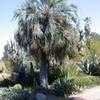
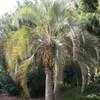
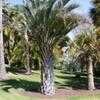
Butia capitata, the Pindo Palm, Wine Palm, or Jelly Palm, is a feather-leaved palm celebrated for its exceptional cold hardiness (to 15–20°F / -9 to -6°C) and its sweet, edible fruits used to make jelly and wine. It's a top choice for palm enthusiasts in temperate climates.

| Classification | Details |
|---|---|
| Family | Arecaceae (ar-ek-AY-see-ee) |
| Genus | Butia (BEW-tee-uh) |
| Species | capitata (kap-ih-TAY-tuh) |
| Synonyms | Cocos capitata, Syagrus capitata, Butia bonnettii, Butia capitata var. odorata |
Native to Brazil, Uruguay, and Argentina, this slow-growing palm forms a stout trunk 10–20 feet tall, crowned with arching, blue-green to gray-green pinnate fronds 5–10 feet long. It thrives in full sun, well-drained soil, and tolerates drought once established. The orange-yellow fruits, about 1 inch in diameter, have a sweet-tart, pineapple-like flavor—excellent for jelly, wine, or fresh eating.
Hardy in zones 8–11, Pindo Palm is one of the few feather palms that withstand significant freezes. It's widely used in Southern U.S. landscapes, Mediterranean gardens, and as a striking container plant. The fruit can be messy near walkways; plant accordingly. Its graceful form and edible bounty make it a dual-purpose treasure.
Pony Tail Palm (Beaucarnea recurvata)
Madagascar Palm (Pachypodium lamerei): Spiny Succulent Tree
Majesty Palm (Ravenea rivularis): Elegant Feather Palm for Interiors
Lucky Bamboo (Dracaena braunii): Twisted Stems for Feng Shui
Foxtail Palm (Wodyetia bifurcata): The Plumose Palm for Tropical Elegance
Bottle Palm (Hyophorbe lagenicaulis): The Unique, Bottle-Shaped Trunk Palm
Impatiens (Impatiens walleriana): The Shade Garden Workhorse
Florist's Cineraria (Pericallis cruenta): The Vibrant Winter Bloomer
Triangle Palm (Dypsis decaryi): The Three-Sided Trunk Palm
Canna 'Musifolia': The Giant Banana Canna
Radicalis Palm (Chamaedorea radicalis)
Joey Palm (Johannesteijsmannia altifrons): Giant Diamond Leaves
Copyright © www.100flowers.win Botanic Garden All Rights Reserved