


Brazil gave the world Pelé — and Roberto Burle Marx, the father of modern landscape architecture. A true Renaissance man: sculptor, jewelry designer, florist, botanist, abstract painter. He was Brazil's first landscape architect to abandon formal European gardens for abstract designs using native Brazilian plants.
Burle Marx translated his paintings and tapestries into three-dimensional landscapes. "Landscape design," he wrote, "was merely the method I found to organize and compose my drawing and painting, using less conventional materials." Completed gardens were to be maintained unaltered — living gallery works.

Born 1909 in São Paulo, Burle Marx studied art in Germany, where Berlin-Dahlem Botanical Garden's tropical plants captivated him. Back in Brazil, he created gardens of native palms, water lilies, orchids, bromeliads. His European art education — cubism, modernism, Dadaism, abstractism — informed his plant use. "I am an artist," he said. "I work with plants."
Unlike contemporaries, he deeply understood his plants. He introduced native species in bold block plantings, became a passionate botanist, joined expeditions discovering new species, and built one of the world's premier tropical plant collections at his 100-acre Sítio estate.


His planting tenets:
"A garden is a complex of aesthetic and plastic intentions," he said. "The plant is... not only a plant — rare, unusual, ordinary or doomed to disappearance — but it is also a color, a shape, a volume or an arabesque in itself."

Designs were created on paper like paintings, transferred to land, but often composed onsite with plants as paint on earth's canvas. This approach stunned Brazilian gardeners accustomed to European traditions. To this British-trained designer, Burle Marx's gardens are a revelation.
Like finished art, his gardens aren't meant to evolve — only be maintained in their intended state. Static, they perfectly complement modernist architecture. In temperate zones, slow-growing evergreens needing minimal clipping achieve similar effect.


Giant mosaics were another signature. Copacabana Beach's 2.5-mile promenade — palm groups set in Portuguese stone wave mosaics — is his most famous. Best viewed from hotel balconies.
Scaled down, pebble mosaics in varied tones create flowing designs that draw the eye through gardens.


Living walls now transfer Burle Marx's organic shapes from floor to vertical plane — massed single-specimen evergreens, no mixed flower colors.
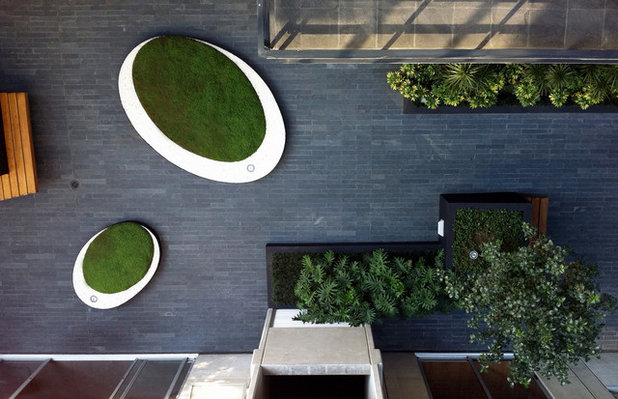
Contemporary designs still reflect his asymmetrical layouts in both structure and planting. Burle Marx died in 1994, remembered for combining stunning design with masterful planting — among the finest landscape companions to modern architecture.
Planting a Memorial Apple Seedling Outdoors in July (Seattle)
Crape Myrtle Planting Distance from Asphalt Driveway
Urban Gardens That Do More: 8 City Spaces Energizing Communities
Growing Crape Myrtle From Seed: What to Expect
Planting Tuscan Kale: Seed Sources and Tips
Growing Persimmon from Seed: Male or Female, Consider Oriental Varieties
Planting 12-Foot Cactus Cuttings: Dry First, Orient Later
Arborvitae Seed Stratification and Seedling Development
Planting Delphinium Seeds in Colorado
Planting Daylilies from Rhizomes (Not Bulbs): Timing and Technique
Seed-Starting Schedule for Perennials and Annuals in Zone 5b: What to Plant Now
Informal Water Garden Planting: Naturalistic Design with Hidden Structure
Copyright © www.100flowers.win Botanic Garden All Rights Reserved