Stone edging brings timeless beauty and structural integrity to landscape borders. From formal cut stone to rustic fieldstone, the right edging stone defines spaces, contains materials, and endures for generations with minimal care.
Why Choose Stone Edging?
- Permanence: 50-100+ year lifespan; doesn't rot, warp, or degrade
- Stability: Weight resists frost heave, soil pressure, equipment bumps
- Aesthetic range: Fits every style—formal to wild
- Dual function: Border + mowing strip + root barrier
- Value: Higher upfront cost; near-zero lifetime cost
Types of Edging Stones
Slate: Sleek & Contemporary
- Appearance: Fine-grained, layered; grays, blues, greens, purples, blacks
- Form: Split-face (natural cleft) or sawn (smooth)
- Installation: Vertical (soldier course) or flat (cap stone)
- Best for: Modern, Asian-inspired, formal; walkway edges
- Note: Can be slippery when wet; sharp edges possible
Flagstone: Natural Flagging
- Types: Sandstone, limestone, bluestone, quartzite
- Appearance: Irregular shapes, natural cleft surface; earth tones
- Installation: Vertical edging (bury 1/3) or flat path edging
- Best for: Naturalistic, cottage, patio transitions
- Pro tip: Sort by thickness for consistent top line
Cut/Dimensional Stone: Precision Architecture
- Materials: Granite, limestone, bluestone, travertine
- Forms: Cubes (4-6"), rectangles, curved units
- Finish: Thermal (flamed), honed, bush-hammered, polished
- Best for: Formal, contemporary, high-visibility edges
- Installation: Mortared on concrete footing for perfection
Cobblestone/Belgian Block: Old-World Substance
- Material: Granite, basalt; 4-6" cubes or rectangles
- Appearance: Rough, weathered; grays, pinks, yellows
- Installation: Sand bed; tight joints; compacted
- Best for: Driveway aprons, formal bed edges, historic properties
- Note: Expensive; heavy; unforgiving curves
Fieldstone/Boulders: Rustic Presence
- Appearance: Rounded, weathered, moss/lichen; local stone
- Installation: Bury 1/3-1/2; cluster naturally; soil contact
- Best for: Naturalistic, woodland, rock garden edges
- Ecological: Source locally; avoid wild collection
River Rock: Smooth Flow
- Sizes: 3-6" (edging), 6-12" (accent)
- Installation: Trench; compacted base; stack 2-3 high
- Best for: Dry stream edges, pond surrounds, informal beds
- Challenge: Round = unstable; mortar or foam adhesive helps
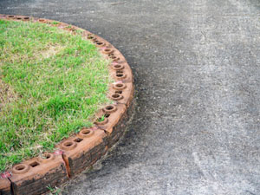
Brick Pavers (on Edge): Classic Versatility
- Patterns: Soldier, sailor, angled, herringbone
- Material: Clay brick (traditional) or concrete brick (economical)
- Installation: Sand bed; polymeric sand joints
- Best for: Curved beds, traditional, DIY-friendly
Decorative Concrete: Custom & Consistent
- Precast units: Scalloped, rope-top, brick-look, stone-look
- Poured-in-place: Custom profiles, integral color, stamped
- Best for: Long straight runs, matching patio/driveway, modern
Cast Stone: Manufactured Elegance
- Composition: Cement, aggregate, pigment; molded
- Appearance: Mimics limestone, sandstone, granite
- Advantages: Consistent, lighter than natural, customizable
- Best for: Formal edging, column caps, matching architectural details
Selection Guide
| Priority | Best Choice | Why |
|---|
| Maximum durability | Granite cobblestone, cast stone | Hardest materials; centuries |
| Modern aesthetic | Slate, dimensional concrete, steel | Clean lines, minimal texture |
| Naturalistic look | Fieldstone, flagstone, river rock | Organic shapes, weathered patina |
| DIY installation | Brick pavers, plastic, wood | Forgiving, lightweight, simple tools |
| Curve flexibility | Metal, brick, small flagstone | Bends without cutting |
| Budget conscious | Concrete pavers, brick, plastic | Low material cost |
Installation Essentials
- Layout with paint/hose; generous curves
- Trench: width = stone + 4"; depth = stone height + 2" base
- Base: 2" compacted crushed stone or sand
- Set stones: level, align, tap with rubber mallet
- Backfill: soil (lawn side); mulch (bed side)
- Joint fill: polymeric sand, mortar, or soil per material
Stone edging is a landscape investment that pays daily dividends: clean lines that make plantings look intentional, mulch that stays put, a mowing strip that eliminates trimming. Choose a material that speaks your garden's language—then install it like you mean it to stay.


