


Few flowers carry as much spiritual weight as the lotus (Nelumbo nucifera). Rising immaculate from muddy waters, it embodies the journey from darkness to enlightenment, making it a central symbol in Eastern religions and a universal emblem of resilience, purity, and divine beauty.
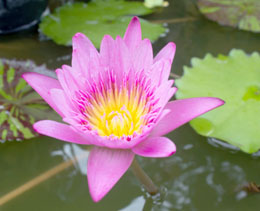
The lotus is an aquatic perennial native to Asia and the Middle East. Its leaves repel water (the "lotus effect"), keeping them clean despite muddy origins. Flowers bloom above the surface on long stems, opening at dawn, closing at dusk. Every part—roots, seeds, leaves, petals—has culinary, medicinal, or ritual use.
The lotus's ability to remain unstained by mud illustrates vairagya—detachment from worldly impurities while living in the world. The Bhagavad Gita (5.10) states:
"Those who dedicate their actions to God, abandoning all attachment, remain untouched by sin, just as a lotus leaf is untouched by water."
The lotus represents the expansion of the soul, spiritual awakening, and the chakras (energy centers), with the thousand-petaled lotus (Sahasrara) crowning the head.
The lotus is one of the Eight Auspicious Symbols. It represents:
| Color | Meaning |
|---|---|
| White | Purity of mind, spiritual perfection, Eightfold Path (8 petals), one of the Four Noble Truths |
| Pink | The historical Buddha (Siddhartha Gautama); his teachings; supreme lotus |
| Red | Purity of heart, compassion, love, passion—qualities of the heart |
| Blue | Victory over senses, wisdom, knowledge, superiority of spirit over intellect |
| Purple | Mysticism, esoteric Buddhism, spiritual royalty |
| Gold | Complete enlightenment, Buddhahood |
Lotus tattoos are globally popular, representing spiritual journey, overcoming adversity, and connection to Eastern philosophy. In yoga studios, the lotus pose (Padmasana) mimics the flower's stability and openness.
Requires: large container (no drainage), heavy loam soil, full sun, warm water (75–87°F), monthly fertilizer. Plant rhizome horizontally, cover with 2–4" water initially, deepen as grows. Blooms in 1–2 years. Hardy in zones 4–10 with winter protection.
The lotus teaches a timeless lesson: our origins don't define our destiny. From the darkest mud, the most exquisite beauty can rise—untouched, untainted, and utterly transformed.
Can a Sundew Produce Multiple Flower Stalks?
Preserving Sarracenia Pollen for Later Use
Identifying a Pink Lisianthus from a Bouquet
Bromeliad Care: Water in Cups, Pups After Flower Dies
New Guinea Impatiens Identification from Florida Photo
Orange Wildflower Near Bunker, Missouri: Possible Poppy Relative
Managing Chickweed in Flower Beds Without Harming Flowers
Flower Gardening 101: From Planning to Perennial Paradise
Peonies: History, Types & Growing These Heirloom Perennials
Flower Gardening for Beginners: Design, Planting, and Care for Beautiful Blooms
Zinnia Flowers: Complete Guide to Growing, Meaning, and Care
Sampaguita (Jasmine Sambac): Meaning, Uses & Cultivation Guide
Copyright © www.100flowers.win Botanic Garden All Rights Reserved