


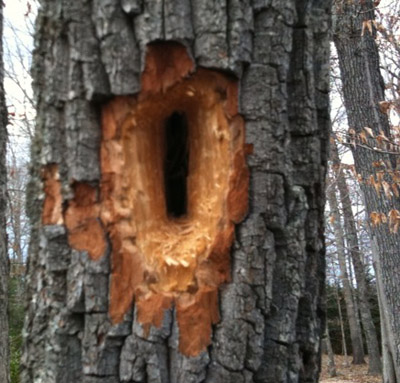
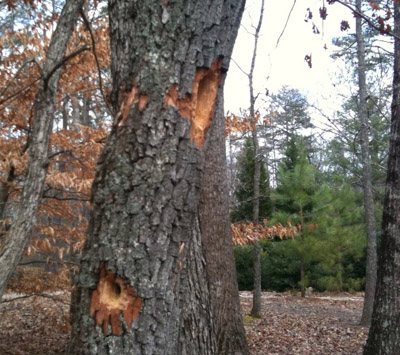
Large, rectangular holes with big wood chips at the base of a sourwood (or other hardwood) tree are the signature of the pileated woodpecker—North America’s largest woodpecker. These aren’t feeding holes; they’re nest cavities.
Pileated woodpeckers prefer trees with soft, decayed heartwood. They locate suitable trunks by drumming and listening to the resonance—a form of sonar. Your tree’s “soft core” made it an ideal nesting site, typically 15 feet or higher up.
Not necessarily. The tree has likely been compartmentalizing decay for years. The woodpeckers are exploiting existing rot, not causing it. Many trees continue thriving for decades with pileated cavities.
These cavities become critical habitat for owls, ducks, bats, flying squirrels, and countless other species that cannot excavate their own homes. Having a nesting pair is a sign of a healthy, mature ecosystem.
Enjoy the show. No intervention is needed. The woodpeckers are protected by federal law, and the tree is doing what trees do: adapting. If the tree eventually becomes hazardous, consult an ISA-certified arborist—but don’t remove it just for the holes.
Rescuing a Root-Bound Crabapple Tree: Diagnosis and Recovery Steps
Sapsucker Holes Don't Cause Scale Insects
Mysterious Yard Holes: Identifying Subsidence from Rotting Tree Roots
Water-Holding Tree Crotch: Don't Drill Drain Holes
Tree Cavity from Broken Branch: Don't Fill It
Filling a Tree Stump Hole: Thinset Mortar is Fine Deep Down
Tree Cavity Care: Why Filling Hollows Does More Harm Than Good
Japanese Maple Red Bug Infestation: Identification Request for Bark-Feeding Pest
Shot Hole Disease on Cherry: Coryneum Blight Management
Managing Borers in Crabapple Trees and Aphids on White Pines
Large Oak Cavity with Standing Water: Drain & Foam, Don't Cement
Concentric Rings of Holes in Bradford Pear: Classic Sapsucker Work
Copyright © www.100flowers.win Botanic Garden All Rights Reserved