


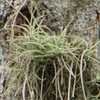
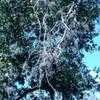
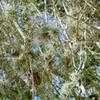
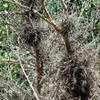
Tillandsia recurvata, commonly called Ball Moss or Air Plant, is a fascinating tiny epiphytic bromeliad native to the Americas from the southern US to Argentina. Despite the name "moss," it's a true flowering plant that grows without soil, absorbing moisture and nutrients through its leaves.
| Family: | Bromeliaceae (bro-mee-lee-AY-see-ee) |
| Genus: | Tillandsia (til-LAND-see-uh) |
| Species: | recurvata (rek-er-VAY-tuh) |
| Synonyms: | Diaphoranthema recurvata, D. uniflora, Tillandsia monostachya, T. pauciflora, T. uniflora |
This diminutive perennial forms dense, spherical clusters 2-6 inches diameter composed of numerous narrow, recurved, gray-green leaves covered in absorbent trichomes (scales). The leaves curl inward, creating the characteristic ball shape. Tiny, inconspicuous violet flowers emerge from the center on short stems, followed by wind-dispersed seeds with silky parachutes.
Ball Moss grows epiphytically on tree branches, power lines, fences, and rocks—anywhere with good air circulation and humidity. It requires no soil, only bright, indirect light, regular misting or humidity, and good air movement. Hardy in zones 8-11; easily grown indoors anywhere with proper care.
Often misunderstood as a parasite, it's actually an epiphyte that doesn't harm host trees. It provides habitat for insects and nesting material for birds. Decoratively, it's used in terrariums, mounted on driftwood or cork, in living walls, and as a curiosity in bromeliad collections. A fascinating example of plant adaptation.
Caring for Bromeliads After the Bloom Fades
Air Plants (Tillandsia) and Travel: Not Suitable for Transport
Mystery Plant Likely Sedum or Agave, Not Bromeliad
Aechmea Bromeliad Post-Flower Care: Offset Management
Blooming Air Plant (Tillandsia) Watering: Mist, Don't Soak
Tillandsia cyanea Care: Mist, Don't Soak; Bright Indirect Light
Bromeliad Care Guide: Light, Water, and Pup Propagation for Long-Term Success
Achieving Cool Night Temperatures for Orchids
Rescuing a Rootless Phalaenopsis: Sphagnum Moss Method
Container Suitability for Sarracenia and Venus Flytrap Bog Garden
Canadian Goldenrod Gall: The "Ball" on the Stem
Air Plant / Lifeplant (Kalanchoe pinnata): Miraculous Leaf Propagation
Copyright © www.100flowers.win Botanic Garden All Rights Reserved