


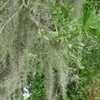
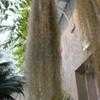
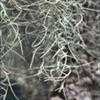
Tillandsia usneoides, universally known as Spanish Moss, is not a moss but a rootless, epiphytic bromeliad that drapes gracefully from tree limbs in humid, subtropical regions. Its silvery-gray, thread-like stems create an ethereal, ghostly beauty.
| Classification | Details |
|---|---|
| Family | Bromeliaceae (bro-mee-lee-AY-see-ee) |
| Genus | Tillandsia (til-LAND-see-uh) |
| Species | usneoides (us-nee-OY-deez) |
| Synonyms | Dendropogon usneoides, Strepsia usneoides, Tillandsia crinita, T. filiformis, T. trichoides |
Native from the southeastern U.S. (Virginia to Texas) through Central and South America to Argentina, Spanish Moss hangs in long, tangled festoons from live oaks, cypress, and other trees. It absorbs water and nutrients through trichomes (scales) on its slender, curved leaves. Tiny, pale green flowers appear in summer, fragrant at night.
It requires high humidity, good air circulation, and bright, filtered light. In cultivation, it's grown draped over branches, wire frames, or in open terrariums. Mist frequently or soak periodically. No soil needed. It's a symbol of the Deep South, used in floral arrangements, mulch, and crafts. A unique, soil-free plant for humid, airy environments.
Caring for Bromeliads After the Bloom Fades
Managing Spanish Moss on Live Oaks: When to Treat and How to Do It Safely
Spanish Moss Control: Copper Sulfate and Manual Removal
Spanish Moss Control on Silver Maple: Copper Sulfate Application
Air Plants (Tillandsia) and Travel: Not Suitable for Transport
Blooming Air Plant (Tillandsia) Watering: Mist, Don't Soak
Tillandsia cyanea Care: Mist, Don't Soak; Bright Indirect Light
Sphagnum Moss vs. Spanish Moss: Different Uses
Bromeliad Care Guide: Light, Water, and Pup Propagation for Long-Term Success
Bromeliad Care: Growing Colorful Tropicals Indoors
Copyright © www.100flowers.win Botanic Garden All Rights Reserved