


Japanese Pittosporum, also called Japanese Mock Orange, Japanese Cheesewood, or Australian Laurel, is a bulletproof evergreen shrub that thrives in the toughest coastal and urban conditions. Pittosporum tobira (family Pittosporaceae) is native to Japan, Korea, and China but has become a global landscaping staple for its tolerance of salt, wind, drought, shade, and pollution.
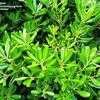
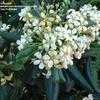
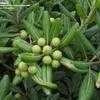
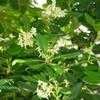
This shrub grows 10-20 feet tall and wide, forming a dense, rounded mound. The leaves are leathery, obovate, 2-4 inches long, glossy dark green, clustered at branch ends. In spring, it produces small, creamy-white, highly fragrant flowers (orange blossom scent) in terminal clusters—surprisingly showy en masse. The fruit is a woody capsule splitting to reveal sticky red seeds.
| Family: | Pittosporaceae |
| Genus: | Pittosporum (pit-oh-SPOR-um) |
| Species: | tobira (TOH-bir-uh) |
| Synonym: | Euonymus tobira |
Japanese Pittosporum is hardy to zone 8a (15°F). It takes sun or shade, any well-drained soil, and responds well to shearing—making it a top choice for hedges, screens, topiary, and foundation plantings. Cultivars: 'Variegata' (cream-edged leaves), 'Wheeler's Dwarf' (compact, 3-4 ft), 'Mojo' (dwarf, dense), 'Cream de Mint' (variegated, compact).
It's a workhorse in coastal Southeast, Gulf Coast, and California landscapes. The fragrance is a bonus near patios and entries. It's relatively pest-free but can suffer from pittosporum psyllid (leaf galls) and root rot in wet soil. For a native alternative in the Southeast, consider Ilex vomitoria (Yaupon Holly) or Myrica cerifera (Wax Myrtle).
Japanese Fiber Banana (Musa basjoo)
Calamondin Orange (Citrus × microcarpa)
Australian Pine (Casuarina equisetifolia): Coastal Survivor with Invasive Tendencies
Japanese Angelica Tree: Bold Foliage & Architectural Spines
Japanese Blueberry Tree: Evergreen Elegance with Bronze New Growth
Japanese Flowering Apricot (Prunus mume): Winter-Blooming Harbinger of Spring
Copyright © www.100flowers.win Botanic Garden All Rights Reserved