


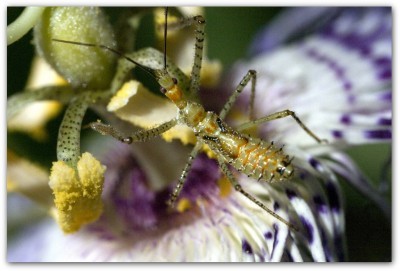
Assassin bugs (family Reduviidae, ~150 North American species) are generalist predators with a distinctive curved, scimitar-like beak. They impale prey—caterpillars, leafhoppers, aphids, beetle larvae, boll weevils—with spiny front legs, then inject digestive enzymes and suck out the liquefied contents. The wheel bug (largest species) has a cog-shaped thoracic crest.
Females lay oval brown eggs on leaf undersides. Nymphs resemble wingless adults, molting 4–7 times over ~2 months. Adults overwinter in bark, leaves, debris. They favor weedy edges, goldenrod, hedgerows, and woodland margins. Slow-moving and cryptic, they’re easily overlooked.
Assassin bugs reduce pest pressure significantly without chemicals. They are not sold commercially but are common in diverse landscapes. Warning: They can inflict a painful bite if handled—similar to a bee sting, with possible allergic reaction. Observe, don’t touch.
These silent stalkers are a hallmark of a balanced garden—welcome them, but give them space.
Comfrey Caterpillars: Organic Bt Spray
Colorado Potato Beetles on Eggplant: Spinosad or Hand-Picking for Control
Deer-Proof Your Garden: Fencing and Natural Deterrents That Work
Natural Garden Fertilizer Decoded: Understanding Labels and Choosing Wisely
Why Natural Fertilizer Outperforms Synthetic Options for Your Garden
Attract Hummingbirds: Create a Complete Habitat in Any Garden
Pill Bugs in Garden: Not Plant Eaters
Stink Bugs Devastating Arkansas Garden: Row Covers + Organic Sprays
Pill Bugs in Raised Beds: Harmless Decomposers
Growing Tulips in Your Garden: A Spring‑Time Delight
Vegetable Gardening from Seed to Harvest: A Complete Guide
Enhancing Your Garden with Decor: Structures, Water Features, and Lighting
Smart Watering: When, How, and How Much for a Thriving Garden
Copyright © www.100flowers.win Botanic Garden All Rights Reserved