



1. Home
  2. Question and Answer
  3. Houseplants
  4. Garden Articles
  5. Most Popular Plants
  6. Plant Nutrition

Fragrant Plants for Every Garden Layer

From the spicy clove scent of dianthus to the sweet perfume of violets, fragrant flowers can transform a garden into a sensory retreat. Below is a curated list of aromatic plants grouped by type—perennials, shrubs, vines, bulbs, and annuals—so you can plan for scent at every level.
Fragrant Perennials

  • Lily‑of‑the‑valley (Convallaria majalis)
  • Dianthus (Dianthus spp.)
  • Lemon lily (Hemerocallis lilio‑asphodelus)
  • August lily (Hosta plantaginea)
  • Catmint (Nepeta faassenii)
  • Peony (Paeonia cultivars)
  • Russian sage (Perovskia atriplicifolia)
  • Summer phlox (Phlox paniculata)
  • Sweet violet (Viola odorata)

Fragrant Shrubs

  • Carolina allspice (Calycanthus floridus)
  • Summersweet (Clethra alnifolia)
  • Winter daphne (Daphne odora)
  • Dwarf fothergilla (Fothergilla gardenii)
  • Gardenia (Gardenia jasminoides)
  • English lavender (Lavandula angustifolia)
  • Winter honeysuckle (Lonicera fragrantissima)
  • Holly osmanthus (Osmanthus heterophyllus)
  • Sweet mock orange (Philadelphus coronarius)
  • Rose (Rosa cultivars)
  • Rosemary (Rosmarinus officinalis)
  • Lilac (Syringa vulgaris)
  • Korean spice viburnum (Viburnum carlesii)

Fragrant Vines

  • Evergreen clematis (Clematis armandii)
  • Moonflower (Ipomoea alba)
  • Jasmine (Jasminum spp.)
  • Gold flame honeysuckle (Lonicera heckrottii)
  • Star jasmine (Trachelospermum jasminoides)
  • Wisteria (Wisteria spp.)

Fragrant Bulbs

  • Hyacinth (Hyacinthus orientalis)
  • Oriental hybrid lily (Lilium cultivars)
  • Jonquil (Narcissus jonquilla)
  • Tuberose (Polianthes tuberosa)

Fragrant Annuals

  • Heliotrope (Heliotropium arborescens)
  • Sweet pea (Lathyrus odoratus)
  • Sweet alyssum (Lobularia maritima)
  • Stock (Matthiola incana)
  • Flowering tobacco (Nicotiana alata)
  • Old‑fashioned petunia (Petunia hybrida)

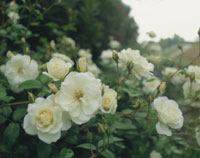
The shrub rose ‘Iceberg’ offers a delicious honey scent.

The Nose Knows: Designing with Fragrance

Fragrance is subjective—what delights one person may overwhelm another. Early‑spring and late‑fall bloomers often have the strongest scents to attract sluggish pollinators. Heirloom varieties tend to be more fragrant than modern hybrids bred for color or disease resistance. Night‑blooming flowers like angel’s trumpet and moonflower release scent after dusk; plant them near patios for evening enjoyment.

Top Fragrant Roses

  • ‘Abraham Darby’ (shrub)
  • ‘Angel Face’ (floribunda)
  • ‘Auguste Renoir’ (hybrid tea)
  • ‘Baron Girod de l’Ain’ (hybrid perpetual)
  • ‘Charles de Mills’ (gallica)
  • ‘Double Delight’ (hybrid tea)
  • ‘Fragrant Cloud’ (hybrid tea)
  • ‘Frederic Mistral’ (hybrid tea)
  • ‘Gertrude Jekyll’ (shrub)
  • ‘Heritage’ (shrub)
  • ‘Iceberg’ (floribunda)
  • ‘Lemon Spice’ (hybrid tea)
  • ‘Louise Odier’ (bourbon)
  • ‘Mme. Hardy’ (damask)
  • ‘Mister Lincoln’ (hybrid tea)
  • ‘Peter Mayle’ (hybrid tea)
  • ‘Scentimental’ (floribunda)
  • ‘Therese Bugnet’ (hybrid rugosa)
  • ‘Zephirine Drouhin’ (bourbon)

Rose scents range from fruity and spicy to heavy, sweet perfumes. Use strongly scented flowers like tuberose and Oriental lilies sparingly—they can overwhelm in mass plantings.

Copyright © www.100flowers.win Botanic Garden All Rights Reserved