


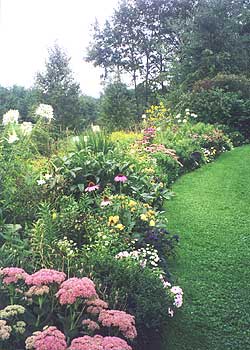
Perennials are the backbone of nearly every flower garden. Unlike annuals, herbaceous perennials die to the ground each season and regrow from the same roots next year. Gardeners love them for easy care, dependability, and enormous variety of color, texture, and form. Here are the basics of design, selection, and care.
Lifespan, bloom time, culture, and form vary widely. Some (lupines, delphinium) are “short-lived” at 3–4 years; others last 15+ years, and peonies can live a lifetime. Bloom may last two weeks or extend over months. Some need deep humusy soil and shade (primroses); others demand well-drained soil and full sun (threadleaf coreopsis, cushion spurge). Some form neat mounds; others (gooseneck loosestrife) take over. Some should be cut back in midsummer; others (hybrid lilies) die if foliage is removed.
With so many species and cultivars, few gardeners know all options. Books are invaluable—photos for ID and inspiration, cultural info, growth habits, bloom time, color, special cultivars. Invest in a good how-to book with cultural details and a color encyclopedia. Fellow gardeners are another great resource: firsthand details on bloom, height, hardiness, culture, and you can see plants in garden settings. You may even score pass-along plants. Ultimately, you won’t know how a plant performs for you until you try it—move it or replace it if it disappoints.
Few “perennial gardens” contain only herbaceous perennials. Woody plants (shrubs, roses, trees) provide backdrop or mass. Annuals/biennials add dependable season-long color. Bulbs give early spring color; ornamental grasses add texture and late-season beauty.
Traditional layouts: border (long, rectangular, 2–4 ft deep, viewed from one side against a backdrop of shrubs, hedge, fence, or wall; classic English borders up to 8 ft deep and 200 ft long, but 3 ft × 12–15 ft works for most) and island bed (floats in lawn, irregular with gentle curves, viewed from all sides, tallest plants along center line, shortest at edges; ideal size 8×15 ft with 5-ft tall center). Repeating themes of plants and colors suit borders; island beds look best generous.
Other styles break rules: rock gardens mimic natural outcroppings for alpines; shade gardens follow tree canopy patterns; large free-form gardens use meandering paths leading through plantings. Perennials can also mix with shrubs, surround mailboxes, fill woodland or streamside areas, or grow in containers.
Appearance depends as much on plant shapes and arrangement as on colors.
Tallest at back of border or center of island bed, descending to shortest at front/edges. Books list average mature height in bloom; many hold flowers well above foliage, so out-of-bloom height may be less. Heights are averages—poor, dry soil yields shorter plants. Be prepared to move plants once you see their true stature; even experts rearrange repeatedly.
Spread is as important as height. Book figures are averages; actual width varies with soil, location, plant age. Don’t place slow-growers next to rapid spreaders—the former may vanish by season’s end.
Goal: full effect ASAP without overcrowding later. Plant drifts of the same variety closer for quick mass. Interplant short-lived, fast-growing plants (Shasta daisies) between slow, long-lived ones (peonies, 3-ft spread in 7 years) for early fullness.
Drifts (5+ of same variety) create repeating color/texture waves—plants as design elements for integrated visual effect. Collector’s gardens (one or two of many kinds) are jumbles of color/texture, higher maintenance, but plant-first, design-second.
Most choices are impulsive—catalog photo, nursery find, neighbor’s cast-offs. For deliberate selection, consider:
Perennials thrive when matched to conditions: sandy or clay soil? Sun or shade? Moist or dry? pH high, low, neutral? Flat, sloped, steep? A good reference book matches plants to your conditions.
If not hardy in your zone, it won’t survive winter. Check USDA Hardiness Zone Map. Altitude, wind, soil, snow cover can shift effective hardiness by a full zone. Choose plants well within your zone. Tempted by borderline plants? If you can afford the gamble, it’s rewarding to grow Zone 5 plants in Zone 4. Unreliable snow cover? Winter mulch (leaves, straw) helps. Well-drained soil prevents heaving damage.
Northern gardeners watch minimum temps; southern gardeners must also heed zones. Many popular perennials (lupines, peonies, garden phlox) need subfreezing periods to flower well. Others won’t tolerate prolonged heat/humidity.
Balance integration and contrast. Too much one color = monotonous; too many = jarring. Organize around one color or theme (pastels, cool, hot). Experiment with different themes in different areas (hot by front door, cool in quiet corner). Remember: most perennials bloom only a couple weeks; foliage texture and form are the “color” most of the year.
Bloom ranges from two weeks to three months. For all-season color, pick several from each bloom season. Spring garden? Focus on April–May bloomers for a spectacular peak. Group 2–3 varieties blooming together for best effect. Specified bloom times are averages—California bearded iris peaks in April, Vermont in June. Record your own bloom times; no book matches your garden’s reality.
Buy the largest, most mature plant you can afford—bigger plants fill out and bloom sooner. Pot sizes range 3–12 inches. Pot-grown perennials plant spring through fall with minimal shock. Bareroot (no soil) perennials ship early spring while dormant; keep roots moist, plant within days. Field-grown perennials (dug at purchase) are largest but need immediate transplant; most nurseries now only offer container-grown.
Vigor can be good or problematic. Overly vigorous plants invade neighbors and take over. Invasiveness is hard to predict—poor conditions tame aggressive plants; fertile soil makes restrained plants invasive. Wary of “vigorous” descriptions—may be a euphemism for invasive. Known invasives: bamboo, Macleaya cordata (plume poppy), Physostegia virginiana (obedient plant), Monarda (bee balm), Artemisia ludoviciana (Silver King artemisia), Lysimachia clethroides (gooseneck loosestrife), Tanacetum vulgare (tansy), Aegopodium (goutweed), Boltonia asteroides.
Eight key steps for a healthy, floriferous garden:
Overwintering Temperate Carnivorous Plants in an Unheated Garage in Zone 6
Iron Toxicity in Plants: Balancing Micronutrients for Acid-Loving Species
Why Zucchini Production Drops in Extreme Heat
Growing Bedding Plants: Seasonal Color for Every Landscape
Designing with Perennial Garden Plants: Color, Height, and Bloom Sequence
Greenhouse Container Growing: Sanitation, Irrigation, and Design Tips
Growing Plants Hydroponically: Benefits, Systems & Crop Choices
Seasonal Houseplant Care: Adapting Water, Fertilizer & Light Through the Year
Growing Coleus – Colorful Foliage for Shade and Sun
Gaura (Wand Flower): Butterfly-Like Blooms on Airy Stems for Hot, Dry Gardens
Growing Hibiscus: Rose of Sharon, Swamp Mallow & Tropical Types
Copyright © www.100flowers.win Botanic Garden All Rights Reserved