Morning Glory (Ipomoea spp.) is the quintessential cottage garden vine—fast-growing, twining stems cloaked in heart-shaped leaves, opening fresh saucer-shaped flowers each dawn. Colors range from classic "Heavenly Blue" to crimson, pink, purple, white, and bicolors. While some species are aggressive self-sowers, with mindful placement they provide quick vertical drama, privacy screens, and pollinator feasts.
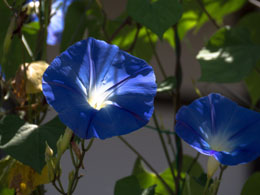
Botanical Overview
- Genus: Ipomoea (500+ species)
- Family: Convolvulaceae
- Native: Tropical Americas; subtropical/temperate Asia
- Type: Annual vine (perennial in frost-free zones)
- Height: 10–20+ ft in one season
- Flowers: 2–4" wide, funnel-shaped; open morning, close afternoon
- Bloom Season: Summer to frost
- Fragrance: Some cultivars (e.g., 'Blue Dawn') are sweetly scented.
- Special Note: Seeds of some species (especially I. tricolor, I. purpurea) contain LSA (ergoline alkaloids)—toxic/hallucinogenic. Keep away from children/pets.
Popular Cultivars
- 'Heavenly Blue' (I. tricolor): Iconic sky-blue with white throat; 10–15 ft.
- 'Grandpa Ott' (I. purpurea): Deep velvet-purple with magenta star; heirloom.
- 'Scarlet O'Hara': Bright red, white throat.
- 'Flying Saucers': White with blue streaks.
- 'Moonflower' (I. alba): Night-blooming, 6" fragrant white flowers; perennial in zones 9+.
- 'Cardinal Climber' (I. sloteri): Feathery leaves, small crimson trumpets; hummingbird magnet.
- 'Blue Dawn' (I. indica): Perennial, vigorous, fragrant blue; 300+ flowers/day in peak.
Growing from Seed
- Timing: Direct sow after last frost when soil ≥65°F (18°C). Or start indoors 4–6 weeks earlier in peat pots (roots resent disturbance).
- Seed Prep: Nick hard coat with nail clippers or soak 24 hrs in warm water to speed germination.
- Sowing: Plant ½" deep, 6–12" apart. Thin to strongest seedlings.
- Support: Install trellis, fence, strings, or arbor at planting time. Vines twine clockwise.
- Germination: 5–21 days. Keep moist.
Site & Soil Requirements
- Sun: Full sun (6+ hours) for maximum bloom. Tolerates light shade but flowers less.
- Soil: Average, well-drained. Not fussy—poor soil yields more flowers, less foliage. Avoid rich, high-nitrogen soil.
- Water: Regular until established; then moderate. Drought-tolerant once rooted.
- Fertilizer: Generally unnecessary. If needed, low-nitrogen (5-10-10) once mid-season.
Care & Management
- Training: Gently guide young vines onto support; they'll twine independently.
- Deadheading: Not required but prevents unwanted self-seeding. Remove spent flowers before seed pods form.
- Controlling Spread: Pull volunteers early. Invasive in some regions (check local lists). Grow in containers to contain roots.
- Pests/Diseases: Rare. Spider mites in hot, dry weather; fungal leaf spots in humidity. Treat organically if needed.
Design Ideas
- Vertical Accent: Teepee, obelisk, or arch in mixed border.
- Privacy Screen: Cover chain-link fence or lattice panel in one season.
- Container: Large pot with trellis; use compact varieties.
- Companion Planting: Pair with moonflower for 24-hr bloom cycle; underplant with low annuals.
- Pollinator Garden: Attracts bees, butterflies, hummingbirds (especially red tubular types).
Caution: Invasive Potential
Ipomoea purpurea and I. hederacea are listed as invasive in several U.S. states. Deadhead diligently, avoid planting near natural areas, and consider sterile hybrids or less aggressive species like I. nil (Japanese Morning Glory).


