


Warblers captivate birders and casual observers alike with their dazzling diversity—over 50 species grace North America. Among them, the yellow-rumped warbler stands out as one of the most widespread, appearing in every U.S. state including Alaska. Yet this seemingly familiar bird holds surprising secrets, from dramatic seasonal plumage shifts to distinct regional subspecies that look like entirely different species.
Order: Passeriformes
Scientific name: Setophaga coronata
Common name: Yellow-rumped warbler
Range: Found at some point during the year in all 50 U.S. states
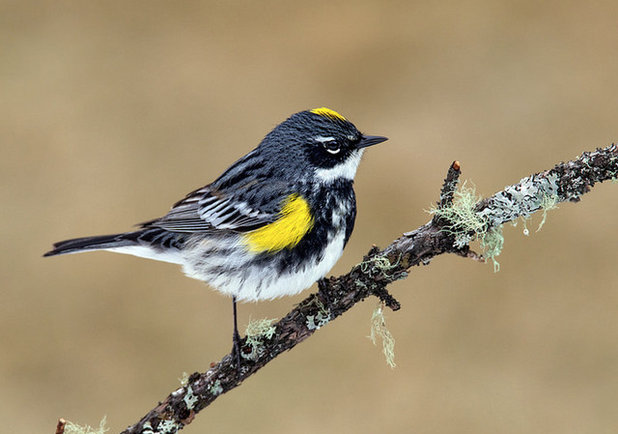
During breeding season, these warblers favor coniferous forests—hemlock, spruce, white cedar, pine, fir, and larch—often nesting along forest edges. Come winter, they shift to shrubby areas, open mixed woods, and even suburban parks where berry-producing natives like bayberry, wax myrtle, juniper, and dogwood provide critical fuel.

Winter finds yellow-rumps across the southern U.S., Mexico, the Caribbean, and Central America. Spring migration sends them north—some breed as far south as Arizona and New Mexico, others push into Canada and Alaska. Birders in northern states enjoy their brilliant breeding plumage, while the central Midwest catches them primarily during migration windows.

The yellow-rumped warbler's most distinctive feature isn't just its namesake rump patch—it's the striking difference between its two main subspecies:
Where their ranges overlap in the central Canadian Rockies, intermediate plumages create a kaleidoscope of variation. In winter, both subspecies molt into muted olive-brown tones with subtle yellow rumps, while summer females of both types show less vibrant patterning than males.


Winter: Plant native berry and seed producers—bayberry (Morella spp.), wax myrtle (Morella cerifera), goldenrod (Solidago spp.), sunflowers (Helianthus spp.), juniper berries, Virginia creeper, and dogwood. Their late fall migration coincides with peak fruit availability.

Summer: These birds switch to an insect-heavy diet—caterpillars, beetles, ants, aphids, flies, and more. A garden rich in native plants supports the insect populations warblers need, especially during nesting. Females build compact 3–4 inch nests in conifer forks using pine needles, animal hair, lichen, and grasses, typically raising one to two clutches of 1–6 eggs.


Males are a stunning deep slate-blue; females are olive-brown—so different they were once classified as separate species. They favor mature forest interiors and forage on insects and fruit. Eastern reforestation has stabilized their populations. Listen for their sweet, buzzy song on your next woodland walk.


These birds breed in the towering conifers of the Pacific Coast and winter in Mexico and Central America. Males sport bright yellow heads with black throats and nape patches; females are duller with olive streaking. Like yellow-rumps, they migrate late—but unlike them, they eat only insects, foraging along conifer branches. They occasionally hybridize with Townsend's warblers where ranges meet.


YardMap is a citizen science project from the Cornell Lab of Ornithology helping people document and improve bird habitat in their yards.

Thinning a Jungle Backyard: Balancing Shade, Privacy, and Aesthetics
Fixing Uneven Flagstone: Selecting Uniform Thickness and Individual Setting
Birds Pecking Your Lawn? It's Probably Earthworms
Creating a Wildlife-Friendly Wild Garden Corner
Design Your Backyard Landscape: A Step-by-Step Approach
Best Bird Deterrents: Top 5 Products to Protect Your Home & Garden
Dog-Proof Ground Cover Solutions for Backyard Dust Control
Persistent Wet Backyard: When to Call a Pro
Wildlife Garden Design: Creating Habitat for Birds, Pollinators, and Beneficial Creatures
Backyard Safety Check: Decks, Sheds & Structures After Winter
Where to Place Bird Feeders for Maximum Activity and Safety
Nuthatches: The Upside-Down Birds That Cache Seeds and Steal Dog Fur
Copyright © www.100flowers.win Botanic Garden All Rights Reserved