


 Due to its vigorous growth, the creeping jenny may turn invasive. So, ensure that you trim the trailing stems on a regular basis. The cultivar with golden foliage is less aggressive, and is not as invasive as the original species.Otherwise known as the 'moneywort plant', the creeping jenny is native to certain parts of Europe. The name moneywort is derived from its round, coin-shaped leaves. The plant is also known as 'herb twopence' and 'twopenny thot'. As the name rightly suggests, the creeping jenny (Lysimachia nummularia) is a creeper, and belongs to the genus Lysimachia in the family Primulaceae. It is very popular as ground covers, trailing plants, and as fillers.The Plant: The creeping jenny has limp, trailing stems, and opposite leaves with wavy edges. The green leaves are almost circular in shape, and are glossy and smooth. The leaves may have black dots, which can be seen if you take a closer look at them. The plant produces yellow, cup-shaped flowers on its leaf axils. The blooming period extends from early summer to fall.The Cultivar: The cultivar named Lysimachia nummularia 'Aurea' is very popular for its lime-green leaves with a golden hue. The foliage color comes out best when the plant is grown in full sun. The yellow flowers are not very conspicuous, due to the golden foliage. Unlike the original species, the cultivar grows at a slow pace, and is not as invasive as the former. Seed formation is also sparse, so the plant does not spread very easily.
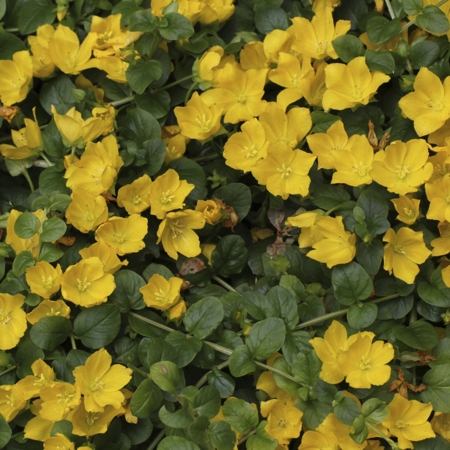 Creeping jenny foliage and flowers
 Lysimachia nummularia
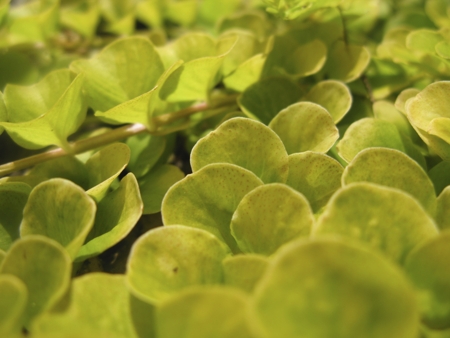 Lysimachia nummularia 'Aurea'Creeping Jenny Plant PropagationThe creeping jenny is a plant that produces seeds that can be used for its propagation. It is also a creeper that develops roots from the leaf nodes when they come into contact with the soil. Even stem cuttings can be used for propagating this plant. Given below are some guidelines about how to grow and propagate a creeping jenny.Root Stem CuttingsStem cuttings can be rooted in soil, potting medium, or water. You can collect the cuttings during spring or early summer. The stem cuttings must have a length of around 3 to 5 inches. A sharp knife or shears can be used to cut the stem tips. Ensure that the cuts are made below the leaf nodes or buds. Before planting them, you have to remove the leaves from the bottom half of the cuttings.
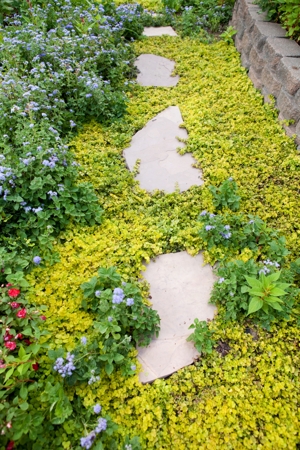 Grown as a ground cover, in contrast with the cement stones on the garden pathwayCreeping jenny cascading over an ivy-covered wall.To conclude, the creeping jenny is a low-maintenance plant that can be propagated without much efforts and costs. This plant can be easily grown in zones 3 to 9. Though they are not fussy, it is advisable to grow them in well-drained, moist, and fertile soil with a pH of 6 to 7.8. They grow well in full sun or partial shade, but exposure to full sun is best for bringing out the foliage color. Young plants need regular watering till they get established. The soil has to be retained moist (not soggy), for adult plants to grow and bloom well.You can feed the plant using a balanced fertilizer once every spring. Pruning is very important, as the plant spreads rapidly and may turn invasive. Trim the trailing stems regularly. You can also pinch off the fading flowers if you want to prevent seed formation. In cooler regions, the plant may turn brown during winter, but it will grow again in spring. Avoid watering the plant during winters. This plant is susceptible to leaf spots, rust fungi, and slug infestation.
Copyright © www.100flowers.win Botanic Garden All Rights Reserved