


Jonathan's D. filiformis 'Florida Giant' (purchased from us) is flowering and setting seed—but the website says this cultivar is sterile. Also, leaves haven't reached the 10–16 inch size. Grown in peat/perlite with sphagnum topdressing, full sun in Oklahoma, distilled water.
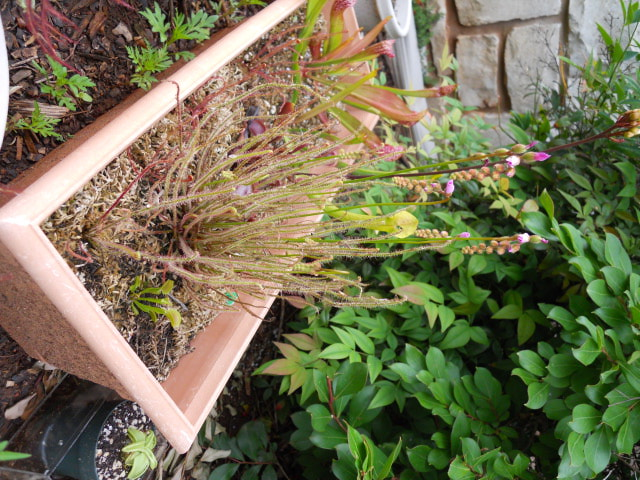
We received a donated batch labeled 'Florida Giant' from seed collected from a customer's original plant—our first red flag, since ours were sterile or reluctant to pollinate. Your plant may be typical D. filiformis or a 'Florida Giant' x typical hybrid. The cultivar isn't a recognized subspecies yet; it's closely related to the type.
We're working to isolate true 'Florida Giants,' but they're indistinguishable when small. Whatever you have is certainly vigorous.
Good Growing!
Jeff Dallas
Sarracenia Northwest
www.cobraplant.com
Dormancy Requirements for Carnivorous Plants in Tropical India
Repotting a Clumping Drosera spatulata
Recovering Drosera Adelae from Light Stress: Pruning Dead Growth and Adjusting Light Levels
Drosera capensis in Eastern Washington: Indoors Only for This Highlander
Drosera intermedia Seeds Require Cold Stratification
Drosera binata 'T-Form' in Eastern Washington: Start Indoors, Move Out in Spring
Sowing Drosera intermedia Seeds: Late September for Spring Germination
Clear Slime on Pygmy Sundew Soil: Slug Trails vs. Algae vs. Mold
Drosera binata T-Form Staying Green: Genetics, Not Culture
Triggering Gemmae Production in Drosera scorpioides
Volunteer Drosera ID: Likely D. spatulata or D. × tokaiensis
Propagating Temperate Sundews from Leaf Cuttings
Copyright © www.100flowers.win Botanic Garden All Rights Reserved