


When hollies show bark damage at consistent heights across multiple plants, it's rarely a single cause. This case reveals three distinct culprits working simultaneously.
Appearance: Irregular, shredded bark patches on lower trunks and exposed branches.
Cause: European hornets (Vespa crabro) strip bark to access sap and use fibers for nest building.
Timing: Most active late summer through fall.
Appearance: Distinctive rectangular patches where bark has been gnawed away, often at consistent heights.
Cause: Squirrels feed on cambium layer, especially in late winter when food is scarce.
Pattern: Often appears at same level on multiple trees—squirrels work along convenient branches.
Appearance: Neat rows of small, evenly spaced holes in horizontal or vertical lines.
Cause: Yellow-bellied sapsuckers (Sphyrapicus varius) drill sap wells, returning to feed on sap and attracted insects.
Note: This is typically cosmetic and rarely kills established hollies.
Correct identification is crucial—each culprit requires a different response. Monitor patterns and timing to confirm which pests are active in your landscape.
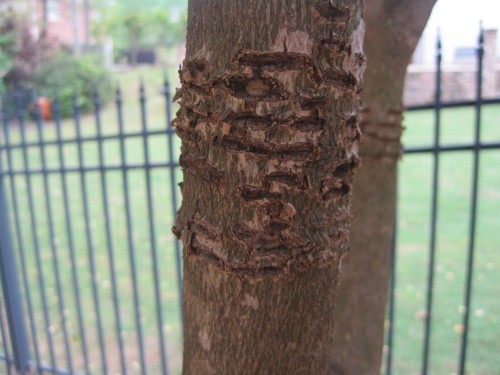
European hornet damage—shredded, irregular bark removal
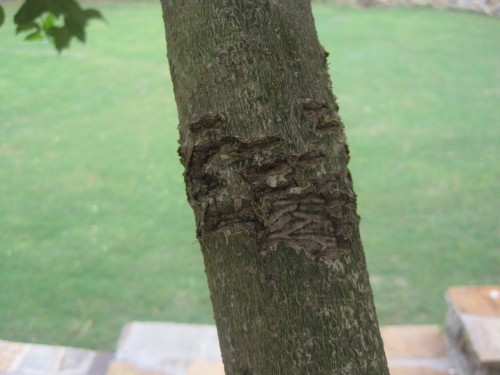
Close view of hornet bark stripping
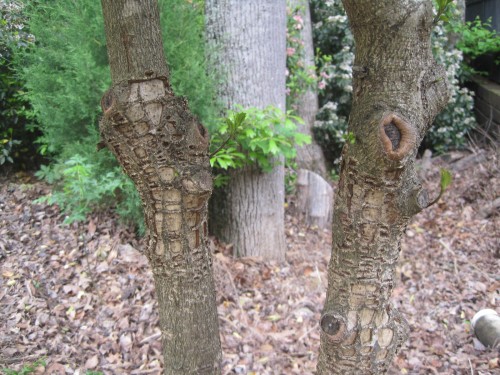
Squirrel damage—rectangular gnawed patches

Sapsucker damage—neat rows of drill holes
Mealybugs on Mounted Orchids: Identification & Treatment on Tree Trunks
Carpenter Ants and Woodpecker Damage on Pine: Don’t Seal the Cavity
Encouraging Mid-Canopy Growth on Transplanted Yaupon Holly
Magnolia Trunk Saw Cut: Let It Heal Naturally
Tornado-Damaged Post Oak with Hollow Trunk: Can It Be Saved?
Maple Trunk Bumps and Hydrangea Leaf Spots: Two Issues
Dog Rope Girdled Young Maple: Assess Cambium, Prevent Borers
Citrus Trunk Weed-Wacker Damage: Mulch, Merit, No Paint
Young Tulip Tree Trunk Wound: Natural Healing
Yoshino Cherry Root Damage from Mower: Mulch and Fertilize
Silver Maple Decline: Lawnmower Root Damage Leads to Rot and Lean
Copyright © www.100flowers.win Botanic Garden All Rights Reserved