


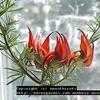
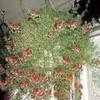
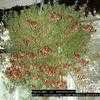
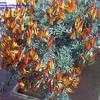
Lotus berthelotii, known as Parrot's Beak, Coral Gem, or Pelican's Beak, is a spectacular trailing perennial endemic to the Canary Islands. Its unique, curved, beak-like flowers in fiery orange-red make it one of the most distinctive flowering plants in cultivation.
| Family: | Papilionaceae (pa-pil-ee-uh-NAY-see-ee) |
| Genus: | Lotus (LO-tus) |
| Species: | berthelotii (berth-eh-LOT-ee-eye) |
| Synonym: | Lotus hornklee |
This prostrate to trailing perennial forms a dense mat of fine, silvery-gray, needle-like foliage that spreads 2-3 feet while staying just 6-12 inches tall. The flowers are the marvel: curved, tubular, 1-1.5 inches long, in brilliant orange-red to crimson, shaped uncannily like a parrot's beak or coral claw. They appear in profusion from spring through early summer.
Parrot's Beak demands full sun, excellent drainage (gritty, sandy soil), and minimal water once established—it's adapted to arid, coastal cliffs. It resents humidity and wet feet. Hardy in zones 9-11; widely grown as a stunning annual for containers, hanging baskets, and rock walls in cooler climates.
Critically endangered in its native habitat—cultivation helps preserve the species. Perfect for hanging baskets, tall containers, rock garden edges, and retaining walls where the trailing stems and beak-like flowers cascade dramatically. The silvery foliage provides year-round interest even when not in bloom. A true collector's plant.
Tall Bearded Iris 'Coral Chalice': A 1982 Niswonger Introduction
Japanese Maple 'Korean Gem': Compact Green from Korea
'Little Gem' Southern Magnolia: Compact Evergreen Elegance
Sedum album 'Coral Carpet': White Stonecrop
ZZ Plant (Zamioculcas zamiifolia): Indestructible Low-Light Houseplant
Salvia 'Coral Nymph': A Delicate Coral-Pink Sage for Pollinators
Tall Bearded Iris 'Coral Point': A 1999 Sutton Introduction
Tall Bearded Iris 'Coral Sunset': Tropical Glow from Schreiner's Palette
Bigleaf Hydrangea Everlasting® Coral: Long-Lasting Mophead for Cutting Gardens
Bihou Coral Bark Japanese Maple: A Yellow-Barked Cultivar
Fireman's Cap (Erythrina × bidwillii): Coral Tree Hybrid
Lantana (Lantana camara): Colorful Clusters for Sunny Gardens
Botanical Tulip 'Bright Gem' (Tulipa batalinii): Yellow Star Flowers
Copyright © www.100flowers.win Botanic Garden All Rights Reserved