Magnolia grandiflora 'Little Gem': The Dwarf Southern Magnolia
For gardeners who love the glossy evergreen foliage and giant fragrant flowers of southern magnolia but lack space for a 60-foot tree, 'Little Gem' is a revelation. This compact cultivar—introduced from a seedling selection by Warren Steed in North Carolina—reaches only 20–25 feet tall with a narrow, pyramidal form, yet produces the same 6–8 inch, lemon-scented white blooms over an exceptionally long season.
Key Characteristics
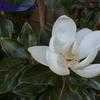
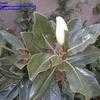
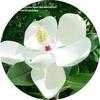
- Flower: 6–8 in. diameter, creamy white, 6–9 tepals, **intensely lemon-fragranced**; borne singly at branch tips. **Bloom: May–November** (sporadic after main flush)—one of the longest-blooming magnolias.
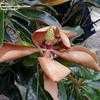
- Foliage: Elliptical, 3–5 in., **glossy dark green above, rusty-brown tomentose (felted) below**—smaller than species. Evergreen.
- Habit: Dense, upright, narrow pyramidal; 20–25 ft tall, 10–15 ft wide. Slow to moderate growth.
- Hardiness: USDA zones 7–9 (some success in protected zone 6b).
Origin and History
- Species: *Magnolia grandiflora* (southern magnolia, bull bay).
- Family: Magnoliaceae.
- Origin: Seedling selection by Warren Steed, Candor, NC (1950s); introduced commercially 1970s.
- Patent: Not patented (old cultivar).
Growing Requirements
- Light: Full sun to part shade; best bloom and density in full sun.
- Soil: Moist, well-drained, acidic (pH 5.0–6.5), rich in organic matter. **Intolerant of alkaline soils** (chlorosis).
- Water: Regular, deep watering; established trees moderately drought-tolerant but best with consistent moisture.
- Mulch: 2–3 in. organic mulch to root zone; keep off trunk.
- Fertilizer: Acid-forming fertilizer (azalea/camellia type) in spring.
Landscape Uses
- Small-yard specimen: Fits where species cannot.
- Evergreen screen/hedge: Dense foliage to ground; plant 8–10 ft apart.
- Espalier: Narrow habit suits wall training.
- Container: Large pots (with winter root protection in zone 7).
- Urban/Street tree: Tolerates pollution, compacted soil better than species.
Advantages Over Species
- Compact size (1/3 height).
- Earlier bloom (young plants flower at 2–3 years vs. 10+ for species).
- Longer bloom season (6 months vs. 6 weeks).
- Narrower form (less pruning).
- Smaller leaves (less litter).
Pests and Diseases
- Generally resistant. Occasional scale, leaf spot, algal leaf spot.
- Chlorosis in alkaline soil—treat with sulfur/iron chelate.
- Verticillium wilt in poorly drained soil.
Comparison: 'Little Gem' vs. 'Teddy Bear' vs. 'Kay Parris'
- 'Teddy Bear' – more compact (15–18 ft), rounder, heavier leaf indumentum.
- 'Kay Parris' – similar size, faster growth, wavy leaf margins, more cold-tolerant.
- 'Little Gem' – most widely available, proven track record.


