


Traveler's Palm is one of the most recognizable and dramatic plants in the tropical world—not a true palm, but a relative of Bird-of-Paradise (Strelitzia) in the family Strelitziaceae. Native to Madagascar, Ravenala madagascariensis forms a spectacular, single-plane fan of enormous leaves that has become a symbol of the tropics.
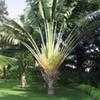
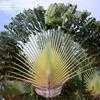
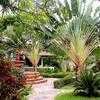
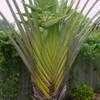
The plant consists of a single, unbranched trunk (palm-like) topped by a distichous (two-ranked) arrangement of 20-30 enormous, paddle-shaped leaves, each 10-15 feet long and 2-3 feet wide, held on long petioles. This creates a giant, flat fan aligned east-west (legend says to guide travelers). The leaf bases form a cup that collects rainwater—hence "Traveler's Palm" for the potable water supply. Mature height reaches 30-50 feet.
| Family: | Strelitziaceae |
| Genus: | Ravenala (ra-VEN-ah-la) |
| Species: | madagascariensis (mad-uh-gas-KAR-ee-EN-sis) |
The flowers resemble Bird-of-Paradise blooms—white with blue bracts, emerging from boat-shaped spathes at leaf bases. They're pollinated by lemurs in Madagascar; elsewhere, by bats and birds. The fruits are brown capsules containing bright blue seeds with edible arils. The "water" in leaf bases is not reliably potable (often contains debris and microbes).
Traveler's Palm requires tropical conditions: full sun, rich, moist, well-drained soil, high humidity, and protection from wind (which shreds the leaves). It's not cold-hardy (damage below 32°F). In marginal climates, it's a spectacular conservatory or atrium plant. It grows relatively fast with ample water and fertilizer. The fan orientation is genetically determined, not sun-tracking. A true living sculpture for frost-free landscapes.
Fishtail Palm (Caryota mitis): Tropical Clustering Palm with Unique Foliage
Buccaneer Palm (Pseudophoenix sargentii): Endangered Florida Palm
Cretan Date Palm (Phoenix theophrasti): Europe's Only Native Palm
Carpoxylon Palm (Carpoxylon macrospermum): The Rare Giant of Aneityum
African Oil Palm (Elaeis guineensis): The World's Most Productive Oil Crop
Joey Palm (Johannesteijsmannia altifrons): Giant Diamond Leaves
Solitaire Palm (Ptychosperma elegans): Elegant Clumping Palm
Chitalpa (× Chitalpa tashkentensis)
Kentia Palm (Howea forsteriana)
Brazoria Palmetto (Sabal × brazoriensis): The Rare Texas Hybrid Palm
Cardboard Palm (Zamia furfuracea): Stiff, Textured Cycad for Containers
Bismarck Palm (Bismarckia nobilis): Silver-Blue Fan Palm for Grand Landscapes
Parlor Palm (Chamaedorea elegans): The Classic Victorian Houseplant
Copyright © www.100flowers.win Botanic Garden All Rights Reserved