


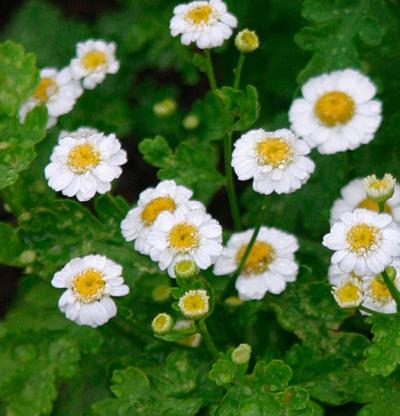
Feverfew (Tanacetum parthenium) is a short-lived, bushy perennial naturalized in much of North America. Fragrant, ferny foliage and composite white flowers with yellow centers appear over a long summer period. Often grown as an annual. 'Aureum' has dwarf habit, smaller flowers, golden aromatic foliage. Other cultivars have double, yellow, or pompom-like flowers. Historically used for toothache, arthritis, headaches, and fever. Foliage may aggravate skin allergies.
Tolerates most any soil except wet and heavy; prefers well-drained, sandy soil in full sun. Propagate by sowing seed at 50–55°F in late winter/early spring, division in spring, or softwood cuttings in early summer. Self-seeds prolifically. Watch for aphids, chrysanthemum nematode, leaf miners.
Mystery Perennial with Ferny Foliage and Purple Clusters
Brunnera (Siberian Bugloss): Shade-Loving Foliage & Flowers
Hibiscus Manihot (Abelmoschus manihot): Giant Yellow Flowers on Tall Ornamental Okra
Tanacetum parthenium: Feverfew with Daisy-Like Blooms and Medicinal History
Festival™ Burgundy Cordyline – Glossy Red-Burgundy Foliage
Black Cohosh (Actaea racemosa): Native Woodland Perennial with Tall White Bottlebrush Flowers
Anise Hyssop (Agastache foeniculum): Lavender Spikes, Mint-Licorice Foliage, Edible Flowers
Lady's Mantle (Alchemilla mollis): Chartreuse, Dew-Catching Foliage for Shade and Borders
Red Aloe (Aloe cameronii): Wine-Red Foliage and Winter Blooms
Vetiver Grass (Andropogon zizanioides): Adaptable Ornamental with Sunset Foliage
New England Aster (Aster novae-angliae): Tall Violet-Purple Sprays
Astilboides (Astilboides tabularis): Giant Lily-Pad Leaves and Creamy White Panicles
Copyright © www.100flowers.win Botanic Garden All Rights Reserved