


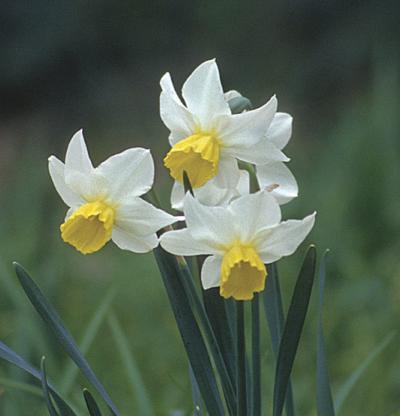
 Daffodil (Narcissus 'Jack Snipe')
nar-SIS-us
Genus:
Narcissus
Generally speaking, daffodils perform best in full sun and well-drained soil, in areas where there is a fair amount of rainfall in the fall and spring and where the summer is relatively dry. However, cyclamineus-type daffodils seem to tolerate at least partial shade and more moisture than others do. Narcissus ‘Jack Snipe’ (pre-1951, Zones 3–8) is a charming example of this type of daffodil. Its white petals are swept back, as if it were standing in front of a fan, and its medium-length, buttercup-yellow trumpet (or nose) sticks straight out at a 90 degree angle from the stem. ‘Jack Snipe’ is an intermediate-size daffodil, standing only 8 to 10 inches tall, and is perfect for a rock garden or the front of a flower border. This whole division of daffodils is becoming more popular not only because it tolerates some shade but also because the shape of the flower is so handsome.
Care:
Grow in average, well-drained soil in full sun or partial shade. In autumn, plant bulbs from 1.5 to 5 times the bulbs' height (3 inches or more in cold climates). Under glass, grow in 1 part grit and 2 parts soil mix. Deadhead seed heads (except those of species, for dispersal) and allow leaves to photosynthesize for 6 weeks before cutting back, including plantings in turf. Lift and divide clumps if they become overcrowded or perform poorly.
Propagation:
Daffodil (Narcissus 'Jack Snipe')
nar-SIS-us
Genus:
Narcissus
Generally speaking, daffodils perform best in full sun and well-drained soil, in areas where there is a fair amount of rainfall in the fall and spring and where the summer is relatively dry. However, cyclamineus-type daffodils seem to tolerate at least partial shade and more moisture than others do. Narcissus ‘Jack Snipe’ (pre-1951, Zones 3–8) is a charming example of this type of daffodil. Its white petals are swept back, as if it were standing in front of a fan, and its medium-length, buttercup-yellow trumpet (or nose) sticks straight out at a 90 degree angle from the stem. ‘Jack Snipe’ is an intermediate-size daffodil, standing only 8 to 10 inches tall, and is perfect for a rock garden or the front of a flower border. This whole division of daffodils is becoming more popular not only because it tolerates some shade but also because the shape of the flower is so handsome.
Care:
Grow in average, well-drained soil in full sun or partial shade. In autumn, plant bulbs from 1.5 to 5 times the bulbs' height (3 inches or more in cold climates). Under glass, grow in 1 part grit and 2 parts soil mix. Deadhead seed heads (except those of species, for dispersal) and allow leaves to photosynthesize for 6 weeks before cutting back, including plantings in turf. Lift and divide clumps if they become overcrowded or perform poorly.
Propagation:
Separate bulbs and replant in early summer or early fall.
Problems:Narcissus bulb fly, narcissus nematode, bulb scale mite, slugs, narcissus basal rot, other fungal infections, narcissus yellow stripe virus, and other viruses.
Copyright © www.100flowers.win Botanic Garden All Rights Reserved