


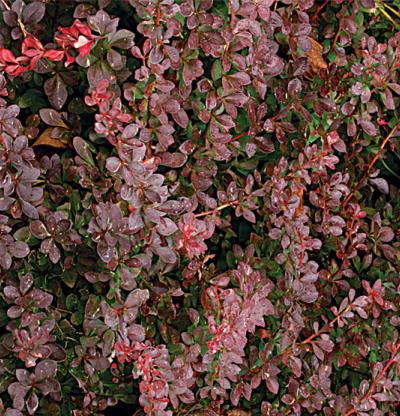
Berberis thunbergii f. atropurpurea, the red Japanese barberry, is a deciduous shrub offering multi-season interest. Its most striking feature is deep reddish-purple foliage—inch-long leaves that hold their color through the growing season. In spring, fragrant yellow flowers appear on arching stems, followed by red berries. The plant's brittle, three-pronged thorns make it an excellent barrier hedge.
Grow in full sun to partial shade with well-drained soil. Prune annually before new growth emerges, removing oldest stems to maintain proportions. Caution: Japanese barberry is listed as invasive across much of the U.S.; check local regulations before planting.
Reaching 6–10 feet tall and 3–6 feet wide, this shrub works well as a hedge, in the middle to rear of borders, or as a specimen. The fragrant flowers attract pollinators, and birds enjoy the berries. Its aggressive growth rate means it fills in quickly but may require containment.
Willow Blue Star (Amsonia tabernaemontana): Blue Flowers and Yellow Fall Foliage
Rue Anemone (Anemonella thalictroides): Delicate White Pinwheel Flowers for Shade
Pussy-Toes (Antennaria spp.): Low Gray-Green Mats for Stepping Stones and Walls
Rocky Mountain Columbine (Aquilegia caerulea): Native Blue and White Beauty
Jack-in-the-Pulpit (Arisaema triphyllum): Native Woodland Perennial with Hooded Flowers
Red Chokeberry (Aronia arbutifolia): Multi-Season Native Shrub
Winter Begonia (Bergenia ciliata): Bold Foliage for Shade Gardens
Heartleaf Bergenia (Bergenia cordifolia): Four-Season Shade Perennial
Callicarpa americana: American Beautyberry for Fall Berries
Camellia japonica: Japanese Camellia for Winter Interest
Campanula cochleariifolia: Fairies' Thimbles for Rock Walls
Campanula persicifolia: Peach-Leaved Bellflower
Copyright © www.100flowers.win Botanic Garden All Rights Reserved