


Before the "money" mystery, the basics: Money Plant or Jade Plant is the most famous succulent Crassula for indoors.  Easy care, amazing longevity. Somewhat more popular in the past—called "old-fashioned" dismissively—but fashions cycle. If you like it, display it proudly.
With age: thick, tree-like branches with fleshy, glossy, smooth, jade-green leaves (hence the name), often with red edges in high light. New stems match leaves, later turning brown and woody—making it a great beginner bonsai.
The "money" lore: two main "money plants"—Jade (Money Plant) and Pachira aquatica (Money Tree). Both central to Feng Shui (harmonizing human existence with environment). Their well-rooted, vibrant energy (seen in new growth) is placed to reflect growing energy in your bank balance. 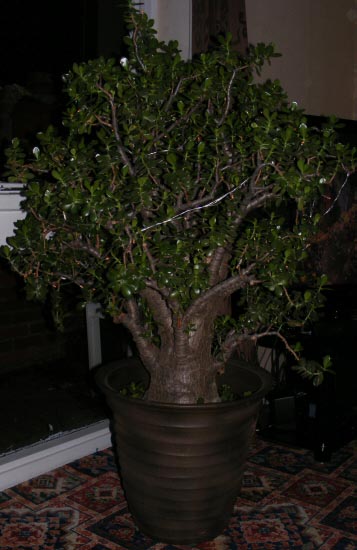 Common in oriental takeaways/shops/restaurants—thriving under artificial light and heat. To customers, they reinforce "mysterious spiritual Orient" stereotypes.
Traditionally given as wedding/housewarming gifts. Longevity means 50-year companions—recipients now richer financially and in life experience. Will it grow your bank balance, pay off mortgage, clear credit cards? Possibly. But possibly not. However, it can live decades—moving homes with you, watching children grow, sharing life experiences. One day, glancing at it in the corner, you may find it's your most priceless living possession.
Great growth in strong natural sunlight. Tolerates slightly darker spots, even windowless rooms (with artificial light).
Like most succulents: tough, adaptable, but won't last with constant overwatering. Water well, wait for soil to dry before repeating. Winter: keep soil barely moist.
No special requirements.
Feed established plants every 3 months in growing season. All-purpose houseplant feed is fine.
Well-ventilated area needed. No fatal upper indoor temperature if ventilated. Watch cold: occasional dips below 10 °C / 50 °F won't kill, but treat as minimum.
They don't need frequent repotting—content in same pot and stale soil for years. Advantage: they get big and heavy! Repot in spring, extra careful with watering until new growth shows. Use free-draining compost.
Easy via leaf or stem cuttings. Fallen/knocked-off leaves: wait 1–2 days for edges to dry, push ¼ way into fresh moist gritty compost (exposed end down). Keep warm, bright (no direct sun), soil barely moist. Tiny plants emerge at leaf base in weeks to months—soon you'll have babies to share. 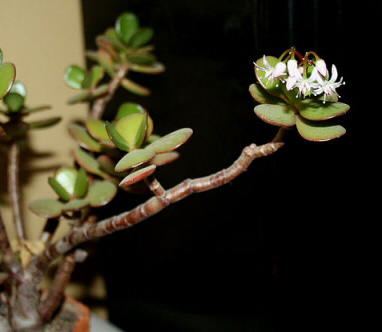 Stem cuttings: same method, bury stem part. More reliable and faster than leaf cuttings.
Slow to moderate early on in good light. At maturity, slow regardless.
Epic: matches human lifespan, can reach 4 m / 12 ft tall, spread >1 m / 3 ft—needs space. But small plants take years to reach this. Maybe by then it's funded your bigger home!
Occasional flowers on mature plants in good conditions: sprays of small white flowers between late autumn and late winter.
Top-heavy plants are disasters waiting. Invest in a heavy container for stability, preventing mess. If it falls: pick up most soil by hand, wait a day for rest to dry, then vacuum without staining.
Jade Plant Leaf Loss: Natural Aging, Watering, and Pruning
"Money Plant" Confusion: Which Species Do You Have?
Large Jade Plant: Prune, Don't Divide
Reviving an Old Jade Plant: Fertilization and Light for Pale Leaf Margins
Jade Plant (Crassula ovata): Lucky, Long-Lived Succulent for Sunny Spots
Jade Plant 'Gollum' (Crassula ovata 'Gollum')
Jade Plant 'Gollum' (Crassula ovata 'Gollum'): The Tubular-Leaf Succulent
Scale Infestation on Jade Plant: Identification and Treatment with Horticultural Oil
Jade Plant Stem Rot: Southern Blight or Crown Rot?
Jade Plant Repotting: Any Time, But Large Pots Heavy; Root-Bound OK
Frozen Jade Plant: Recovery First, Repot Later
Aggressive Mealybug Treatment for a Large Jade Plant
Money Tree (Pachira) Longevity: No Fixed Lifespan
Crassula (Jade Plant) Disease Management: Bacterial Rot and Powdery Mildew
Copyright © www.100flowers.win Botanic Garden All Rights Reserved