


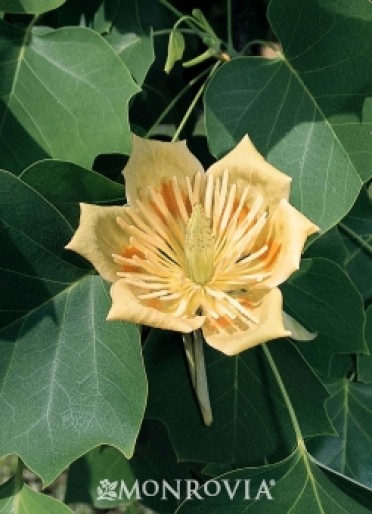

The Tulip Tree (Yellow Poplar) commands attention with its straight, massive trunk and distinctive bluish-green leaves—uniquely shaped like a tulip silhouette or a cat's face. In autumn, the foliage ignites in spectacular golden-yellow, lighting up the landscape.
In late spring to early summer, mature trees produce showy, tulip-shaped flowers—greenish-yellow with orange bases—high in the canopy. While not conspicuous from ground level, they add to the tree's botanical interest. Fast-growing and long-lived, this deciduous giant reaches 35–50 feet tall (eventually much taller) with a 20–35 foot spread. Best for large properties, parks, and naturalistic plantings.


Powdery Mildew on Tulip Tree: Identification and Management
Tulip Poplar Drought Response: Deep Watering and Trunk Protection
Mature Tulip Poplar Limb Drop: Heart Rot Ecology
Orchid Tree 'Purple': Exotic Rich Purple Blooms Over Long Period
Redbud 'Eastern': Rosy-Pink Flowers on Bare Branches, Yellow Fall Color
Why Your 20-Foot Tulip Tree Won't Bloom: Fixing the Nitrogen-Phosphorus Imbalance
Tulip Poplar (Liriodendron) Suitability for South Central Kansas
Japanese Fern Tree Near Swimming Pool: Root Damage Risk?
Root Depth and Spread of Swamp and Emerald Cedars
Tulip Poplar Trunk Split After Drought Watering
Tulip Tree in Partial Shade: Ontario Zone 5 Alternatives
Rooting Globe Willow Cuttings: Indoor Temporary, Outdoor Permanent
Copyright © www.100flowers.win Botanic Garden All Rights Reserved