


It has wicked thorns, it laughs at herbicides, and it always seems to come back no matter how much you pull it from your shrubs each spring. Nobody smiles when smilax vine appears.
The pest is smilax (also called deer thorn or catbrier), one of the toughest perennial vines a gardener must contend with. The thorny vine with waxy, heart-shaped leaves wends its way through azaleas, English laurel, and perennial flower beds with impunity. Smilax produces berrylike fruit that birds enjoy, but this vine is no joy to control.
As smilax begins to grow from seed, it sends up a single shoot and produces an underground bulb. As the plant matures, a large cluster of bulbs forms. Only a few shoots arise from the root mass; the majority of bulbs lie dormant. If you kill one shoot, that bulb may die, but adjacent bulbs can send up new shoots within days.
Greg MacDonald, Extension weed specialist, says control should focus on early detection before more bulbs form. If you find this noxious vine, dig it up rather than chopping it down. Try to remove all bulbs from the ground. The only other option is frequent sprays of a systemic herbicide like Roundup or Brush-B-Gon. Eventually the root mass will be depleted, but the process may take months, even years.
Q: I have an evil force at work under my yard—a network of sticker vines growing along a seemingly endless root system. I went on a rampage years ago and dug up most of my yard. Now the vines seem to have mutated and are back in full force. I'm ready to try anything short of a nuclear attack! Please help me KILL THE EVIL ALIEN STICKER VINES!!!
A: I hear your frustration! Tough vines like wisteria, English ivy, and kudzu are a headache to eradicate. My guess is you have smilax, also called green briar, deer thorn, and "that *^!!( %* !! sticker vine." Smilax has a deep taproot that allows it to re-sprout no matter how many times you chop it down. Weed chemicals don't easily penetrate its glossy leaves. Short of calling in a bulldozer, how can you control the vine or get an effective herbicide down to the root system?
Here's an idea to try on a warm spring day: Mix three gallons of diluted Roundup™ solution in a five-gallon plastic bucket. Find sticker vines that have grown several feet long, pull them off the ground, and drape as much vine as possible into the bucket. Let each vine soak for fifteen minutes to absorb maximum herbicide.
After soaking, dispose of surplus pesticide responsibly. Roundup has a good environmental safety record and is inactivated when it touches soil. Dig a shallow hole away from desirable plants and pour the leftover solution there, or strain and use it to spray other weeds.
NOTE: I've gotten good control spraying Roundup twice, at two-month intervals, on a smilax thicket on my mother's property.
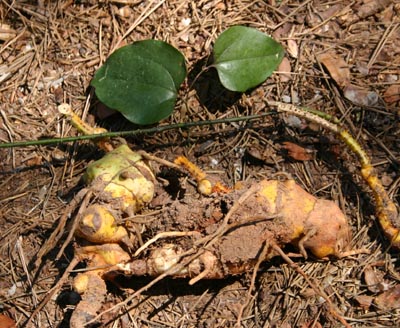
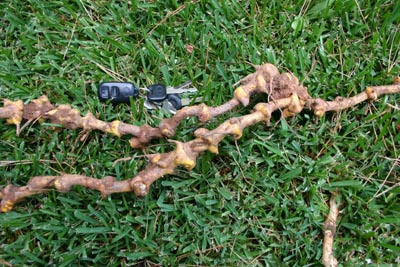

neighbor holding long smilax root
Growing Grass and Vines in Deep Shade with Compacted Soil
UV Filters Don't Control Hair Algae: Here's What Does
Pest Control During Pregnancy: Safety Protocols, Green Options, and Risk-Benefit Analysis
Parsley Piert Control in Bermudagrass: A Multi-Year Battle
Crabgrass Identification and Prevention in Bermuda Lawns
Mulch Selection and Depth for Hillside Erosion Control in San Diego
Organic Pest & Disease Control: Work With Nature for a Healthier Garden
Squash Bugs: Copper Eggs = Act Now, Smash or Spray, Rotate Crops
Identifying and Controlling Air Potato (Dioscorea bulbifera), an Invasive Yam
Organic Eradication of Smilax (Green Briar) Without Herbicides
Henbit vs. Purple Deadnettle: ID and Control
Mistletoe Control: Understanding Ethephon Treatment and Limitations
Copyright © www.100flowers.win Botanic Garden All Rights Reserved