


Lawrence Halprin (1916–2009) was a visionary who brought modern design to the land, revitalized neglected urban areas, and pioneered ecological conservation decades ahead of his time. Born in Brooklyn, he spent three formative teenage years on a kibbutz in what is now Israel — an experience that profoundly shaped his collaborative, community-centered ethos. After earning degrees from Cornell and the University of Wisconsin (where he met his wife, avant-garde dancer Anna Schuman), he studied at the Harvard Graduate School of Design under Walter Gropius and Marcel Breuer.
Schuman's influence was pivotal. Her choreographic mindset inspired Halprin to incorporate movement notation — "motations" — into his design process, treating landscapes as scores for human movement. A visit to Frank Lloyd Wright's Taliesin East cemented his path.
After a Navy stint, Halprin landed in San Francisco, beginning his career with modernist landscape pioneer Thomas Church. His Western portfolio includes icons: Ghirardelli Square, Sea Ranch, the Seattle World's Fair grounds, and Portland's eight-block sequence of public spaces. His later FDR Memorial in Washington, D.C. (designed 1974, completed 1997) saw him personally selecting quarry boulders.
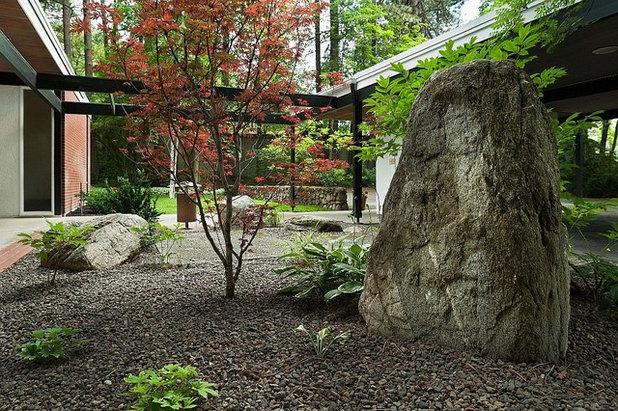
Halprin designed this landscape while in Spokane for another project. The forward-thinking Ferris couple, owners of one of the town's first modern homes, commissioned him. The family has preserved his vision for 60+ years.
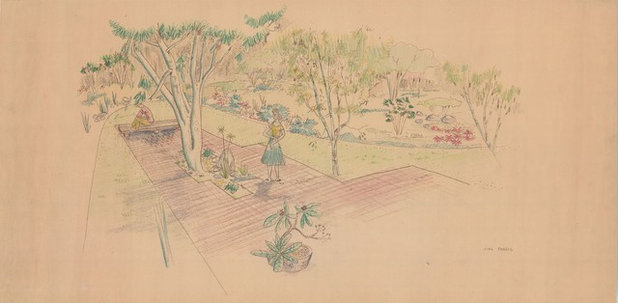
A sketch reveals Halprin's user-first approach: he envisioned how the Ferrises would actually inhabit the space — a hallmark of his practice.

Conceived with architects Charles Moore, Joseph Esherick, William Turnbull, Donlyn Lyndon, and Richard Whitaker, Sea Ranch clustered homes to preserve meadows and share ocean views — kibbutz-inspired collective stewardship. Houses were sited to withstand gusty winds while respecting the land.


The southern portion retains these principles remarkably well.

Halprin addressed highways severing cities by capping a freeway with a park. Brutalist forms made it popular, though it later fell into disrepair. Recent lighting, security, and pruning have revived it. Its legacy inspires projects like Boston's Big Dig — burying highways to reconnect cities to waterfronts.

Amid misguided urban renewal nationwide, Halprin designed an eight-block sequence of connected open spaces honoring residents' love for the Columbia River, Cascades, and mountain meadows while acknowledging urban character — reminiscent of Olmsted's Emerald Necklace.

His sketchbook pages reveal "motations" — movement notations mimicking dance scores.

Lovejoy Plaza was designed for concerts, sculpture shows, even dancers arriving from above the fountain.

Lovejoy Fountain remains iconic. "The fountains & plazas are formed to link up with nature, not copy her," Halprin wrote. He abstracted natural processes to fit urban needs.
Halprin's legacy endures: designers and planners study his work, but more importantly, people inhabit his spaces as he imagined — moving, gathering, connecting. The Lawrence Halprin Landscape Conservancy works to protect this heritage.
Wheelbarrow Design Ideas from a Landscaper's Perspective
Hand-Pollinating Vanilla Orchids: Step-by-Step Guide
Black Spot on Knockout Roses: Does Dyed Mulch Harm Plants?
Stabilizing a Newly Planted, Shaky Dogwood
Mystery Nepenthes from Open House: Likely maxima Hybrid, Parentage Unknown
Personal Reconnection: Armco Steel Memories and Herb Journey
Pruning Schefflera for Fullness: Timing and Technique
When a Viewer Asks: "Were You on Judge Judy?"
Spinach Germination in Early Spring: Patience Pays
Best Online Garden Design Tools: Plan, Visualize & Succeed
The Role of a Garden Designer: Art, Science & Sustainable Beauty
Garden Design Principles: Structure, Style, and Unity
Garden Design Principles: Create a Garden That Works for You
Copyright © www.100flowers.win Botanic Garden All Rights Reserved