


Stepping stones beckon you on a journey—to your front door or a secluded garden spot. Whatever their purpose, getting them right pays off. Ask yourself these seven questions before selecting and installing.
 Outhouse Design
Choosing paver format is often the trickiest decision. "It comes down to garden style and feel," says Josh Harrison of Harrison's Landscaping. "For natural feel, use circular, organic-shaped stones like sandstone flagging or organic bluestone. For structured, formal looks, choose square or rectangular pavers." Ideal sizes: ~16×32 inches or 20×20 inches.
 Landscape And Architectural Design Products PL
Height is critical. "Too low, grass grows over them—you'll hand-trim forever. Too high, you can't mow over them. I set them at soil level so grass blades sit above the paver," Harrison advises.
 Tim Davies Landscaping
Stride out placement before installing. "Nothing worse than steppers too close—you end up shuffling," Harrison says. Average stride is ~18 inches. Place stone centers 18 inches apart for the primary users. Mark locations with spray paint or golf tees.
Spacing is even more critical over water—excessive concentration on foot placement ruins the "walking on water" experience.
 Christopher Design
 Sam Crawford Architects
In healthy lawns, no infill needed. But shady or rocky sites need alternatives. This Sydney backyard has steppers beside a living room opening to a south-facing grassed courtyard—in full winter shade. "Grass won't grow, so cast-in-situ concrete steppers are set among native violet—a groundcover tolerating foot traffic," says architect Sam Crawford. Random sizing and spacing reinforce informality.
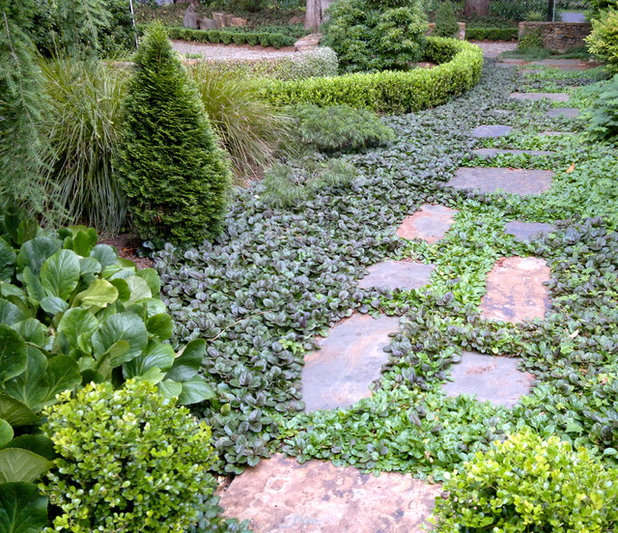 Arthur Lathouris Garden Designer
Arthur Lathouris also chose groundcover over grass: "Ajuga reptans 'Catlin's Giant' flowers in spring—spikes 6–8 inches high, a sea of purply blue."
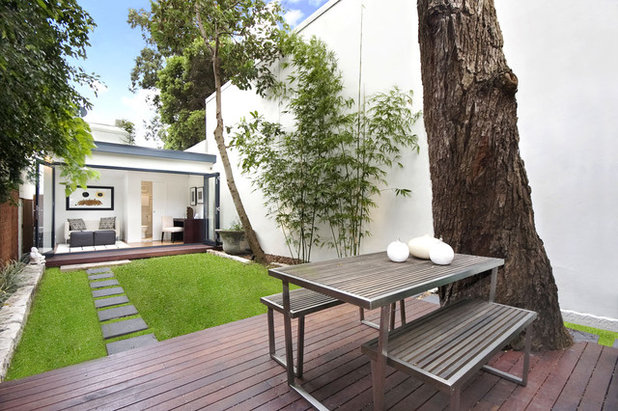
Steppers linking a terrace house to a back home office installed on artificial grass—zero maintenance, always freshly mown. Stones create a pathway without dominating. Sandstone garden edgers are recycled foundation stones from the original house.
Most sit on builder's sand for maximum stability. However, stones settle over time from moisture and foot traffic, occasionally needing lifting for more sand or soil. Cement is an option for rock-solid foundations. In this Perth garden, steppers are mortared in. To cover cement and create a striking dry riverbed effect, natural glacial river stones from Western Australia fill the gaps.
 Harrison's Landscaping
You might assume steppers suit only backyards, but this front garden uses light granite pavers to draw the eye toward a stone-clad water feature with floating bench and granite tiling. Two 12×24-inch pavers laid end-to-end create each larger stepper. "They create a soft pathway to access the side of the house. We didn't want hard paving across the front—it would detract from the garden," Harrison explains.
 Dean Herald-Rolling Stone Landscapes
Here, steppers ideally link paved area and wooden deck, preventing an over-paved backyard look. Lighting adds designer edge and ambience.
Tip: Ensure lawnmower can safely pass over stones, or maintenance becomes a chore. If a stone rocks when stepped on, adjust sand to stabilize.
 Harrison's Landscaping
Since steppers often install in garden beds or lawns, Harrison avoids porous materials like sandstone, preferring hard-wearing bluestone, granite, or travertine.
Tip: Feeling creative? Consider mosaic stepping stones.
Tell us: Have tips for Houzzers considering stepping stones? Share in Comments.
Summer Houseplants Outdoors: Chipmunks & Bug Prevention
Fall Cleanup: What to Do with Dead Perennials and Annuals — Leave, Cut, or Dig?
Designing Beautiful Garden Steps: Materials, Dimensions & Construction
Garden Stepping Stones: Creative Pathways for Personal Expression
Garden Stepping Stone Walkways: Complete Installation Guide
Garden Stepping Stone Walkway Installation: Detailed How-To Guide
Fixing White Marble Rock Borders That Flood and Wash Out: Drainage, Barriers, and Base Prep
Blue Italian Cypress Container Holding and Spacing for Privacy Screen
Sarracenia Thrips Outbreak: Orthene (Acephate) Beats Imidacloprid
Key Questions to Ask Before Hiring a Landscape Architect
Critical Questions When Buying Traditional Radiators
Copyright © www.100flowers.win Botanic Garden All Rights Reserved