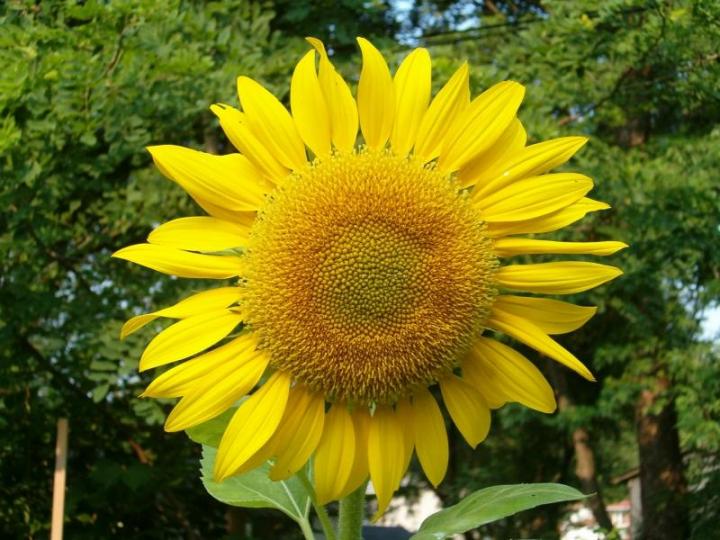
This grew from a seed a squirrel buried for later.
Jeff Childrey
Where to buy sunflowers: Burpee Gardening
Sunflowers say "summer" like no other plant. American natives, grown for beauty and harvested for seed.
Annual plants with big, daisy-like faces of bright yellow (occasionally red) petals and brown centers ripening into heavy seed-filled heads.
Tall and coarse with creeping/tuberous roots and large bristly leaves. Some exceed 16 feet; others bred for small spaces and containers.
Remarkably tough and easy if soil isn't waterlogged. Heat- and drought-tolerant. Excellent cut flowers; attract bees and birds.
Learn why you should grow these happy flowers.
Planting Sunflowers
- Best in direct sun (6–8 hours/day); prefer long, hot summers for good flowering.
- Long taproots need room—prefer well-dug, loose, well-draining soil. Prepare bed: dig 2 feet deep, ~3 feet across to prevent compaction.
- Well-drained location; prepare 2–3 feet circumference to 2 feet depth.
- Slightly acidic to somewhat alkaline (pH 6.0–7.5) ideal.
- Heavy feeders—soil needs nutrient-rich organic matter/composted manure. Or work slow-release granular fertilizer 8 inches deep.
- If possible, shelter from strong winds (along fence or near building).
- Decide before planting if you want a sunflower tower.
Planting Sunflower Seeds
- Direct-sow after spring frost danger passes. Ideal soil temp: 55–60°F.
- Give room, especially for branching low-growers. Rows ~30 inches apart (closer for tiny varieties).
- Plant large seeds ≤1 inch deep, ~6 inches apart after thorough warming (mid-April to late May). Plant multiple, thin to strongest at 6 inches tall.
- Light fertilizer at planting encourages strong roots against wind.
- Stagger plantings over 5–6 weeks for continuous blooms.
- If birds scratch for seeds, net planted area until germination.
Care
- While small, water root zone (~3–4 inches from plant). Snail/slug bait around stem helps.
- Once established, water deeply but infrequently for deep roots. Unless exceptionally wet/dry, water weekly with several gallons.
- Feed sparingly; overfertilization causes stem breakage in fall. Dilute fertilizer in water, avoid plant base—build a moat ~18 inches out.
- Tall types need support. Bamboo stakes work for strong single stems needing temporary support.
Pests and Diseases
- Birds/squirrels love seeds. For seed harvest, use barriers. As heads mature and droop, cover with white polyspun garden fleece.
- Deer: tall wire barrier.
- Relatively insect-free. Small gray moth lays eggs in blossoms—pick worms off.
- Downy mildew, rust, powdery mildew. Early fungal detection: spray general garden fungicide.
Harvest and Storage
- For bouquets: cut main stem just before bud opens to encourage side blooms.
- Cut early morning. Midday cutting causes wilting.
- Handle gently. Flowers last ≥1 week in room-temp water.
- Arrange in tall containers for heavy heads; change water daily.
Harvesting Sunflower Seeds
- Watch for ripeness: back of head turns green to yellow, bracts dry and brown (~30–45 days post-bloom, seed moisture ~35%). When head back turns brown, seeds usually ready.
- Cut head ~4 inches below flower; remove seeds with fingers or fork.
- Protect from birds: cover with cheesecloth + rubber band, or cut early and hang heads upside down to dry indoors/safe from birds/mice.
Recommended Varieties
Everyone knows towering 8-foot giants, but some top out at 15 inches.
- 'Mammoth' — traditional giant, excellent for snacks/bird feed.
- 'Autumn Beauty' — spectacular 6-inch flowers in yellow, bronze, mahogany on branching stems to 7 feet.
- 'Sunbeam' — standout bouquet flower, van Gogh type, 5-foot plant, 5-inch pollenless rich golden-yellow rays.
- 'Teddy Bear' — 2–3 feet, perfect for small gardens/containers. Fluffy deep-gold 5-inch blossoms last days in vase.
Wit & Wisdom
- Bird feeder? Save dry heads for winter.
- Thick stems dry for winter kindling.
- Anonymous buyer paid $39M+ in 1987 for van Gogh's Sunflowers.
- Kansas: "The Sunflower State."
Here and yonder, high and low,
Goldenrod and sunflowers glow.
—Robert Kelley Weeks (1840–1876)
Cooking Notes
- Small black seeds: cooking oil, margarine, cosmetics, animal feed; best for attracting diverse songbirds.
- Large striped seeds: snacking, bread, health foods; feed larger birds (jays, mourning doves).
- For eating: dry on plant, rub off, soak overnight in salted water (1 cup salt/gal), oven-dry at 250°F 4–5 hours. Store airtight.
- Remove seeds by rubbing head across old washboard.


