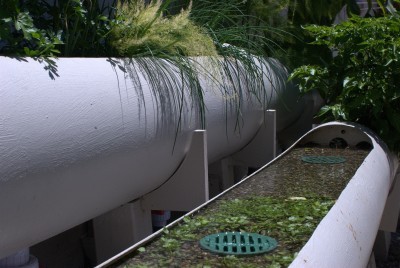
Aquaponics = aquaculture (fish) + hydroponics (plants) in a recirculating loop. Fish waste → bacteria → plant nutrients → clean water → fish. Zero waste, 90% less water, dual harvest. Here's the complete backyard aquaponics guide: system types, components, cycling, and management.
| Type | Description | Best For | Complexity |
|---|
| Media Bed (Flood & Drain) | Gravel/clay pebble bed, bell siphon floods/drains | Beginners, diverse crops, robustness | Medium |
| Raft / DWC | Plants on floating rafts, roots in trough | Greens, herbs, high density, commercial | Medium |
| NFT (Nutrient Film Technique) | Thin film in channels, constant flow | Greens, herbs, vertical, space-efficient | High |
| Vertical Towers | Pockets in vertical columns, drip irrigation | Small footprint, strawberries, herbs | High |
| Hybrid | Media bed + raft/NFT combined | Max diversity, buffer capacity | High |
Essential Components Checklist
- Fish tank: 100–300 gal (IBC tote, stock tank, pond liner). 1 gal water per 1" fish.
- Grow bed(s): 1:1 to 2:1 ratio with fish tank volume.
- Pump: Circulates full system volume 1–2x/hr. Submersible or external.
- Air pump + stones: Fish tank + grow beds (if media). Critical.
- Plumbing: PVC (schedule 40), bulkheads, valves, uniseals. No copper (toxic to fish).
- Filtration: Solids removal (swirl filter, radial filter) before grow beds.
- Heater/chiller: Species-dependent. Tilapia 75–85°F, trout 55–65°F.
- Lighting: Sun (greenhouse) or LED grow lights (indoor).
- Test kits: pH, ammonia, nitrite, nitrate, DO, temperature. Daily → weekly.
Safe Materials (Fish & Food Safe)
- HDPE (#2), PP (#5), LDPE (#4) — totes, tanks, pipes.
- EPDM pond liner (non-fire-retardant).
- Fiberglass, stainless steel.
- Rigid PVC (schedule 40).
- Black flexible PVC tubing (no copper, no vinyl with plasticizers).
- Avoid: galvanized (zinc), concrete (pH), treated wood.
System Cycling (4–6 Weeks Before Fish)
- Fill, run pump/air. Add ammonia source (pure ammonium chloride, 2–4 ppm).
- Daily test: ammonia → nitrite → nitrate.
- When ammonia 0, nitrite 0, nitrate rising → cycled.
- Add fish at 20% stocking density. Ramp up over weeks.
- Plant seeds/seedlings in media/rafts.
Best Fish for Backyard Aquaponics
| Species | Temp Range | Hardiness | Harvest | Notes |
|---|
| Tilapia | 75–85°F | Very hardy | 6–8 mo | Warm water only. Breed prolifically. |
| Catfish | 70–85°F | Hardy | 12–18 mo | Bottom feeders. Good for cool shoulder seasons. |
| Trout | 55–65°F | Sensitive | 12–14 mo | Cold water. High DO needed. Premium eating. |
| Perch / Bluegill | 65–75°F | Moderate | 12+ mo | Native, tasty. Slower growth. |
| Goldfish / Koi | 60–75°F | Very hardy | Ornamental | Not for eating. Great for learning. |
Best Plants for Aquaponics
- Excellent (high N demand): Lettuce, kale, spinach, basil, mint, watercress, bok choy.
- Great: Tomatoes, peppers, cucumbers, beans, peas, strawberries (need K supplement).
- Good: Herbs, flowers, microgreens.
- Challenging: Root crops (media depth), heavy fruit (K, Ca supplements needed).
Ongoing Management
- Daily: Feed fish, check temp, water level, pump/air flow.
- Weekly: Test pH (6.8–7.0), ammonia, nitrite, nitrate. Clean filters.
- Monthly: Check fish health, plant roots, plumbing, solids buildup.
- Harvest: Stagger planting for continuous yield. Remove spent plants.
Aquaponics is a living ecosystem, not a machine. It demands observation, patience, and respect for the biology. Start small (IBC tote + 2 media beds), learn the cycle, then scale. The reward: fish + vegetables from one integrated, water-wise system.
Copyright © www.100flowers.win Botanic Garden All Rights Reserved