


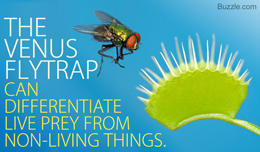
 Animals catching their prey is not unusual, but do plants do the same? Yes, some members of the plant kingdom are well equipped to trap and digest insects. Venus flytrap is one of the popular carnivorous plants, with its trap-like leaves. The extraordinary method it uses to trap its prey seems to be the nature's equivalent to sensor technology. It grows in the wild and is found only in North and South Carolina in the United States. This plant is an ode to adaptation, as it consumes insects as a source of nitrogen needed for protein formation. It is a small plant with four to seven leaves that grow from a short subterranean stem. The stems usually reach the maximum height of 3 to 10 centimeters (5 inches). When the plant matures, it may produce flowers on a single tall stalk, far above the leaves.What do Venus Flytraps Eat and Why?These plants are carnivorous and they feed mainly on insects. It has been observed that a major part of their diet constitutes ants and spiders. Even beetles, grasshoppers, crickets, slugs and caterpillars are found to fall prey to these plants. Venus flytraps are capable of producing food through photosynthesis. Then, why do they need insects? The answer is that their native habitat (swamps and bogs) has soil that is poor in nutrients. So, in order to procure key nutrients like nitrogen, these plants digest insects.True Leaves are the Traps
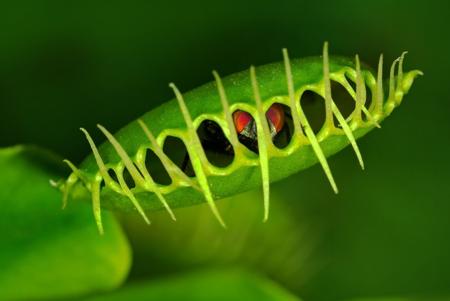 It is the leaves of this plant that form traps for catching insects. The heart-shaped petioles form the long and flat leaf-like structures of the plant. The true leaves are found as traps on the tips of the petioles. The trap part is divided into two segments that are attached together by the midrib. The trap being hinged at the midrib, can close shut and open again. The edges of the lobes are fringed with stiff hair-like protrusions, that form a mesh, preventing the prey from escaping when the lobes snap shut.Traps With Bait and Sensors
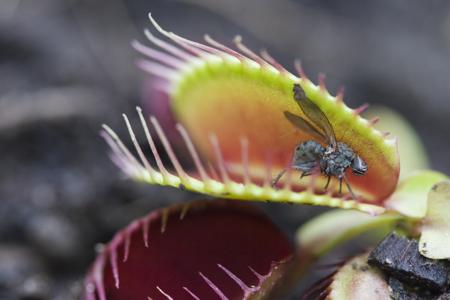 These traps produce nectar with a sweet smell, so that insects get attracted to them. The inner surfaces of these traps have small sensitive hair that help the plant sense the presence of the prey. These hair trigger the trap to close shut, as and when the insect touches them. Sophisticated Trapping MechanismIt is really amazing to know why the traps do not close on each and every trigger. It has been discovered that the sensitive hair need to be triggered at least two times in quick succession (i.e., within 20 seconds), so as to activate the trap. Otherwise, a single hair must be touched twice or thrice in quick succession. This helps the leaf traps to differentiate live insects from non-living things like stones or raindrops. These traps take only one-tenth of a second to shut. The time taken may vary as per the health and growth conditions of the plant.What Happens When the Trap Closes?
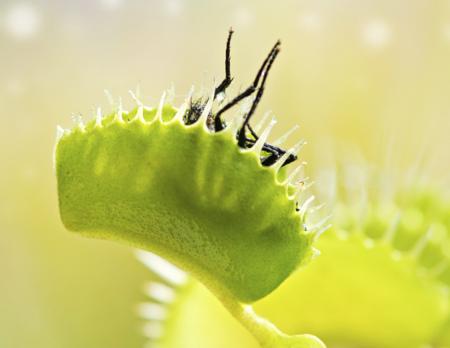 While a live insect on the leaf trap can trigger its closure, even a small stone, raindrops or fallen sticks can cause the same. An ideal prey must be one-third the size of the trap. If the prey is of a larger size, some parts of the insect will stick out and the trap will close partially only. As there is no airtight seal around the prey, mold and bacteria will enter the trap and act on the insect as well as the leaf trap. The leaf trap will rot and fall off.
 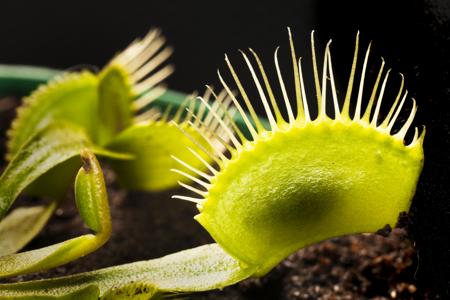 The movements of the trapped insect trigger production of digestive juices that are secreted from the glands located on the inner surfaces of the leaf trap. The insect is bathed in the digestive juices for a few days. The enzymes also kill the bacteria and mold that are already present in the prey. While the soft parts of the prey are digested and the nutrients are absorbed, the hard exoskeleton is discarded. Once the digestion part is done, the digestive juices are reabsorbed and the trap opens up. The remains of the insect get removed by wind or rain. The whole procedure takes around ten to twelve days. Short-lived Trapping MechanismThough the leaf traps have the ability to catch insects, they too have a limit. In other words, each leaf trap can open and close for around six to seven times, after which they focus completely on photosynthesis (before they fall off). Otherwise too, the digestive juices produced by an older leaf will be weaker. Whether it be partial or complete closures, the ability of trapping insects is not a long-term one.Growing Venus Flytrap
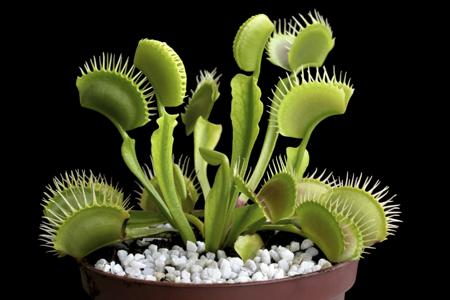 Venus flytrap is a fairly popular plant as its curious appearance lends to its ornamental value. However, it is said to be difficult to grow, and people often learn to care for a Venus flytrap only after killing a few of them. The key lies in replicating the plant's natural habitat as closely as possible. While getting a new sapling, it is important to determine its health condition. An indication of good health in most varieties of the Venus flytrap is the bright color of the leaf traps. If you notice any problem in the plant, do not choose it for cultivation and look for a plant with good health condition. Here are some pointers for the successful cultivation of the Venus flytrap:
Copyright © www.100flowers.win Botanic Garden All Rights Reserved