


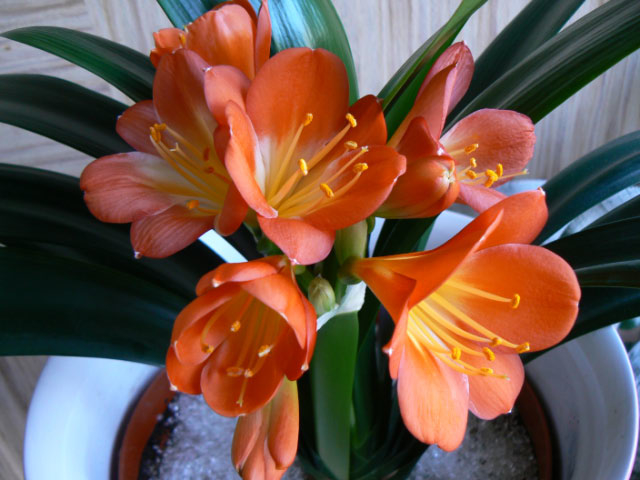
The Clivia plant (Clivia miniata), often called the Kaffir Lily, is a striking flowering houseplant native to South Africa. A close relative of the amaryllis, it boasts long, arching, dark-green leaves that emerge from a thick, bulbous base. In late spring to early summer, mature plants produce dense clusters of 15–20 trumpet-shaped blooms in shades of orange, red, yellow, or cream, each about 2–3 inches wide. The flower stalk rises above the foliage, creating a bold display that lasts roughly four weeks.
Clivias thrive in bright, indirect light and prefer to be slightly root-bound. Water thoroughly when the top inch of soil feels dry, but reduce watering in winter to encourage blooming. They enjoy average home temperatures (60–75°F) and moderate humidity. Use a heavy clay or ceramic pot to counterbalance the plant’s top-heavy growth—mature specimens can reach 2–3 feet tall and wide.
All parts of the Clivia plant contain lycorine and other alkaloids, making it toxic to pets and children if ingested. Keep it out of reach and wash hands after handling.
Whiteflies Killing Potted Annuals on Screened Porch
Unisexual Flowers and Self-Pollination: Monoecious vs Dioecious
Hibiscus: Tropical Blooms Indoors for Warm, Sunny Rooms
Lipstick Plant (Aeschynanthus): Trailing Blooms for Bright Indirect Light
Peperomia (Radiator Plant): 1,000+ Varieties of Thick-Leaved Charmers
Pothos (Epipremnum aureum): The Ultimate Beginner Trailing Plant
Snake Plant (Sansevieria trifasciata): Indestructible Air Purifier for Any Light
Eugenia Dieback: Systemic Atomic Grow for Vascular Cleansing
Transplanting a Gift Azalea Outdoors: Timing and Care Tips
Best Plants for Clay Soil and Planting Size Advice
Narrow-Space Privacy Plants for St. Louis Gardens
Saving 'Jelly Bean' and Hens & Chicks from Georgia Rains
Why Won't My Venus Flytrap Close? The Critical Role of Light
Rescuing Sarracenia from Fungal Rot: Radical Rhizome Surgery and Rehabilitation
Copyright © www.100flowers.win Botanic Garden All Rights Reserved