


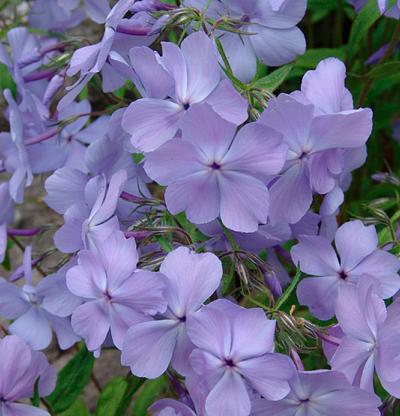
Phlox divaricata 'Blue Moon' has round, full flowers with overlapping petals and particularly rich blue‑violet color. Use in rock gardens, alpine houses, dry walls, or as edging. Spreads by roots, creating a semi‑evergreen groundcover.
Humus‑rich, fertile, moist but well‑drained soil in part shade.
Basal cuttings in spring, root cuttings in early autumn/winter. Problems: powdery mildew, stem canker, rust, Southern blight, stem nematodes, leaf spots, leaf miners, caterpillars.
Beds, borders, cut flower; rock garden, woodland garden.
| Height | 1–3 ft. |
| Spread | 1–3 ft. |
| Growth Habit | Spreads |
| Light | Part Shade Only |
| Moisture | Medium |
| Maintenance | Low |
| Bloom Time | Early Spring, Spring |
| Flower Color | Blue, Purple |
| Type | Perennial |
Agastache 'Blue Fortune' (Agastache 'Blue Fortune'): Cold-Tolerant Hybrid with Powder-Blue Spikes
Blue False Indigo (Baptisia australis): Native Perennial with Blue Spikes and Black Pods
Evolvulus 'Blue My Mind': True Blue Blooms Without Deadheading
Fothergilla 'Blue Shadow': Compact Native with Fragrant Flowers & Blue Foliage
Phlox '21st Century Blue Star': Cool-Season Star-Patterned Phlox
Phlox '21st Century Blue': Classic Cool-Season Blue
Wisteria 'Blue Moon Kentucky': Hardiest, Reblooms Up to Three Times
Geranium 'Johnson's Blue': Classic Lavender-Blue Saucer Flowers
Blue Oat Grass (Helictotrichon sempervirens): Powder Blue Foliage for Architecture
Hosta 'Blue Angel' (Hosta 'Blue Angel'): Very Large Blue Hostas with Heavily Textured Leaves
Ilex × meserveae: Blue Holly with Glossy Blue-Green Leaves and Red Berries
Blue Flax: Sky-Blue Blooms for Sunny, Lean Soil
Copyright © www.100flowers.win Botanic Garden All Rights Reserved