


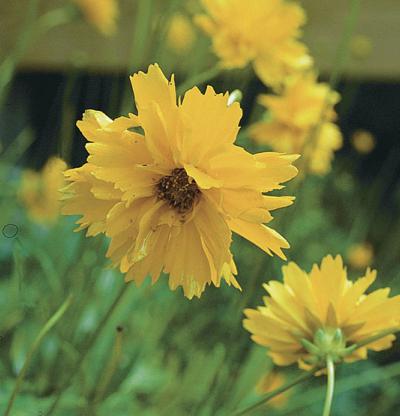
Coreopsis grandiflora 'Sunray' (kor-ee-OP-sis gran-dih-FLOOR-ah) has double to semi-double yellow flowers that begin blooming in late spring and continue throughout the summer. The species is native to the central and southeastern U.S. Flowers are good for cutting. Use in beds, borders, or containers.
Grow in full sun or partial shade and fertile, well-drained soil. Deadhead regularly, although birds are attracted to the seedheads.
Start seeds at 55° to 61° F in winter.
Slugs, snails, rust, bacterial spot, Botrytis flower blight, aster yellows, powdery and downy mildews, fungal spots.
Hollyhock (Alcea rosea): Tall, Classic Cottage Garden Biennial with Colorful Spikes
Stars of Persia (Allium christophii): Huge, Metallic Fuchsia Spheres for Early Summer
Drumstick Allium (Allium sphaerocephalon): Color-Changing Blooms for the Summer Garden
Angelonia (Angelonia angustifolia): Heat-Loving Summer Bloomer for Containers
Golden Marguerite (Anthemis tinctoria): Long-Blooming Daisy-Like Flowers
Marguerite Daisy (Argyranthemum frutescens): Continuous Blooms for Containers
Coreopsis lanceolata – Lance-Leaved Coreopsis, Native Wildflower
Figwort (Asarina scandens): Half-Hardy Climber with Indigo to White Flowers
Heath Aster (Aster ericoides): Native Clumping Perennial with Small White Flowers
Bigleaf Aster (Aster macrophyllus): Heart-Shaped Leaves Turning Mauve in Autumn
Tickseed Sunflower (Bidens aristosa): Late-Summer Gold for Meadows
False Chamomile (Boltonia asteroides): Late-Summer Clouds of White and Pink
Borage (Borago officinalis): Edible Blue Flowers for Herb Gardens
Copyright © www.100flowers.win Botanic Garden All Rights Reserved