


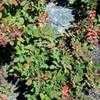
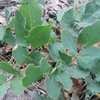
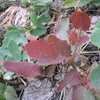
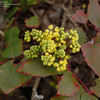
Creeping mahonia (Mahonia repens), also called creeping barberry or creeping hollygrape, is a low, spreading evergreen shrub native to western North America. It offers year-round interest: fragrant yellow spring flowers, powder-blue summer berries, and holly-like foliage that turns bronzy-purple in winter.
Stems creep via underground rhizomes, forming colonies 30–45 cm tall and 1–2 m wide. Leaves are pinnately compound with 3–7 spiny, leathery leaflets, each 2–5 cm long. In April–May, dense racemes of bright yellow, lightly scented flowers appear. By late summer, these develop into glaucous, blue-black berries (edible but tart). Winter foliage takes on rich reddish-purple tones.
| Family: | Berberidaceae (bear-ber-id-AY-see-ee) |
| Genus: | Mahonia (ma-HO-nee-uh) |
| Species: | repens (REE-penz) |
| Synonyms: | Berberis pumila, B. repens, B. sonnei, Mahonia pumila, M. sonnei |
Flowers provide early nectar for native bees and hummingbirds. Berries feed birds (robins, towhees, waxwings) and small mammals. Foliage offers cover for ground-nesting birds. Deer resistant due to spiny leaves.
Ideal for woodland edges, under conifers, on slopes, and in native plant gardens. Combines well with sword ferns, salal, and Oregon grape (M. aquifolium). Slow to establish but long-lived and low-maintenance. Prune only to remove old stems.
Ball Cactus (Parodia magnifica): A Handsome Globe with Silky Yellow Spines and Crown of Flowers
Carpet Weed (Cheiridopsis candidissima): A Silvery, Mat-Forming Mesemb from South Africa
Sausage Tree: Africa's Bizarre & Beautiful Kigelia
Veronica repens 'Sunshine': Creeping Speedwell – Golden Foliage with Blue Flowers
Korean Mint (Agastache rugosa): Robust, Licorice-Scented Perennial for Tea and Pollinators
Common Barberry (Berberis vulgaris): Thorny Shrub with Tart Berries
Telegraph Plant (Desmodium gyrans): Leaf-Moving Curiosity
Florist's Cineraria (Pericallis cruenta): The Vibrant Winter Bloomer
Pregnant Onion (Albuca bracteata): Curious Bulb with Baby Offsets
False Freesia (Anomatheca laxa): Dainty Red Star Sprays
Green Dragon (Arisaema dracontium): Native Jack's Long-Tongued Cousin
Copyright © www.100flowers.win Botanic Garden All Rights Reserved